Best Passive Income Ideas for Beginners with No Experience
Jun 03, 2026
Most passive income advice assumes you already have something — savings to invest, an audience to sell to, or a product ready to go.
This post is for the person who has none of that yet.
No capital. No existing audience. No product. Just the decision that trading time for money indefinitely isn't the plan, and the question of where to actually start.
I've been building passive income streams for over a decade. I've also spent a lot of that time talking to coaches, creators, and regular people who want to do the same thing. The starting point is almost always the same, and it's simpler than most guides make it sound.
Here's what actually works when you're starting from zero.
Start Here: What "No Experience" Actually Means in This Context
When most people say they have no experience building passive income, what they usually mean is they've never set up a system that generates money without their direct involvement.
What they often do have — without realizing it — is knowledge, skills, or a process that other people would pay to access.
You don't need to be an expert in passive income to build it. You need to be skilled or knowledgeable at something — anything — that someone else wants to learn or shortcut.
A marketing coordinator who's great at content calendars. A personal trainer who has a client intake process that works. A teacher who's developed lesson frameworks over years in the classroom. A bookkeeper who knows what most small business owners get wrong.
None of these people would describe themselves as having "passive income experience." All of them have something worth packaging.
That reframe matters before we get into the list, because it changes what you're looking for. You're not searching for a passive income idea from scratch. You're looking at what you already know and asking: how do I package this so it can sell without me?
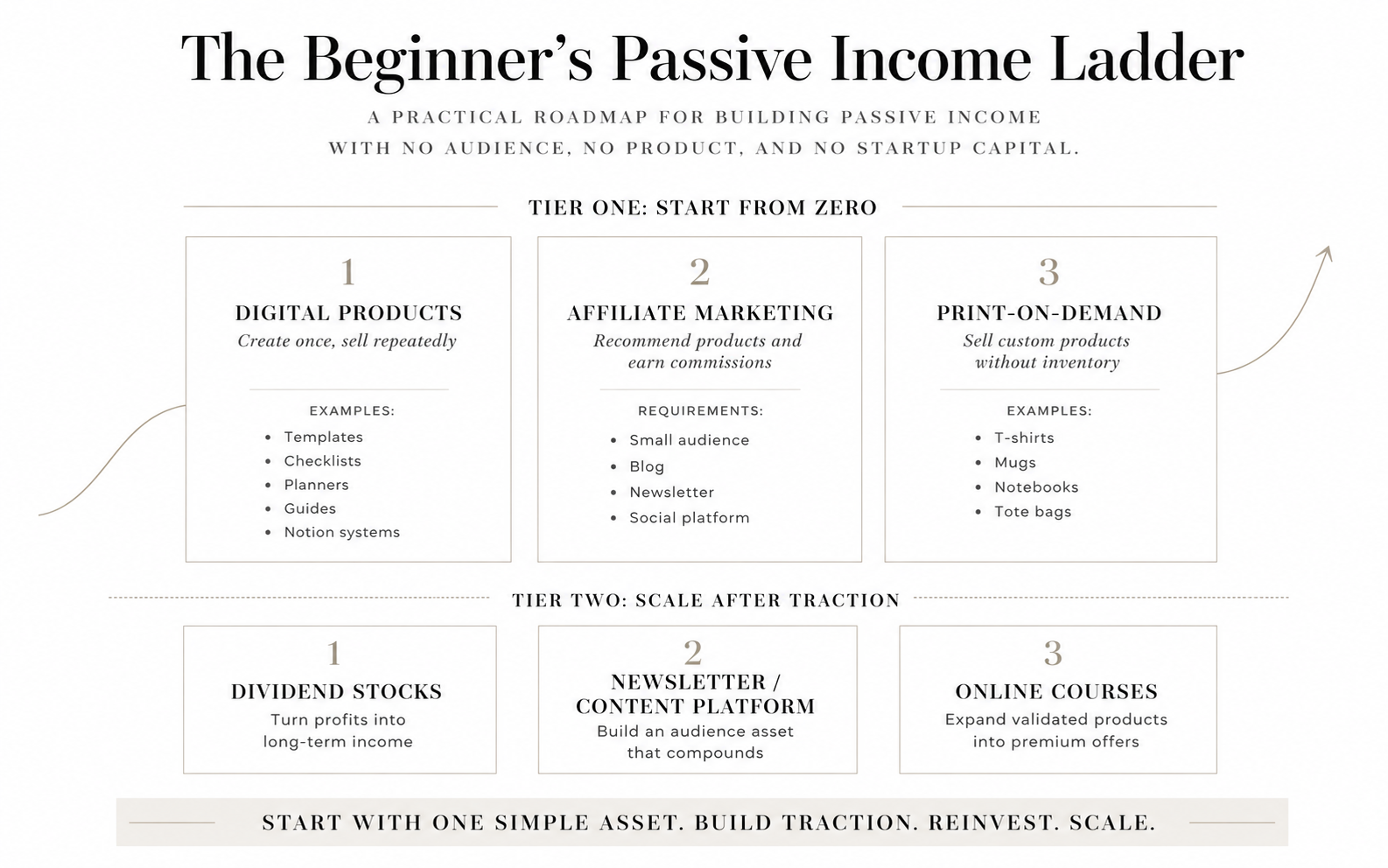
Tier One: Where to Start When You Have Nothing Yet
These are the ideas that require the least upfront capital, the least technical knowledge, and the least existing infrastructure. If you're genuinely starting from zero, this is your list.
Downloadable digital products
This is the highest-leverage starting point for most beginners, and it's where I'd tell almost anyone to start.
A digital product is something you create once and sell repeatedly without any fulfillment cost. Once it's live, you don't ship anything, hold any inventory, or do anything to deliver it. The file goes out automatically. The money comes in.
The simplest versions to start with: ebooks and PDF guides, cheat sheets and quick-reference documents, checklists and SOPs, trackers and planners, Notion templates, Canva templates, and spreadsheet templates.
None of these require specialist software or technical skills to build. Most can be created in Canva, Google Docs, or Notion in a weekend. The barrier to entry is low, the ongoing effort is minimal, and the potential to compound over time is real.
Price point for beginners: $7 to $27 is a natural range for simple digital products. Low enough that it's an easy purchase decision. High enough that volume adds up.
Where to sell them: Etsy is the easiest starting platform for most people because it has built-in search traffic. You don't need an existing audience to make sales — the platform brings buyers to you. More on this in Part 3 of this series.
Affiliate marketing
Affiliate marketing means earning a commission when someone buys a product or service through your unique link. You don't create the product. You recommend it, and you get paid when someone follows through.
The catch for true beginners: affiliate income works best when you have some platform to recommend from — a blog, a newsletter, a social following, a YouTube channel. If you have none of those yet, this one is harder to start cold.
That said, it's worth knowing about from day one because the setup cost is zero and the commissions can be significant. Programs like Amazon Associates, the Kajabi Partner Program, and countless others pay 10-50% per sale. If you're already recommending tools and resources to anyone in your life, you should be getting paid for it.
Start building this as soon as you have any platform at all, even a small one.
Print-on-demand products
Print-on-demand services like Printful or Printify let you create designs that get printed on physical products — t-shirts, mugs, notebooks, tote bags — only when someone orders. No inventory, no upfront cost, no fulfillment on your end.
The design side can be done in Canva. The technical setup takes an afternoon. The ongoing work is essentially zero once your shop is live.
The honest caveat: margins on print-on-demand are thin, and standing out in a crowded market takes either strong design skills or a very specific niche. It works well as an add-on stream rather than a primary income source, especially early on.
The Digital Product Starting Point
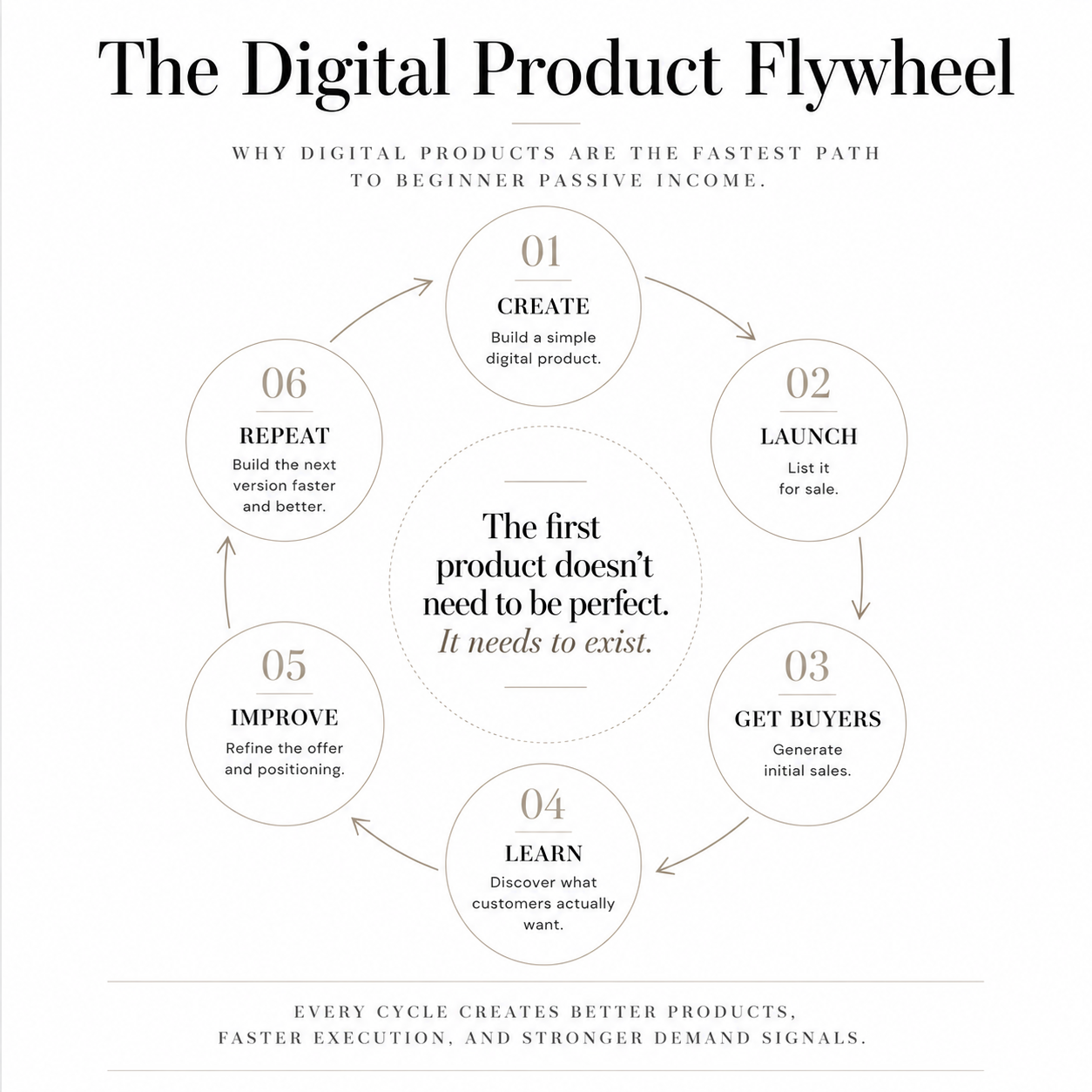
Of everything in Tier One, digital products are the place I'd focus first — and the reason comes down to speed, scalability, and the feedback loop they create.
Here's what I mean by that last one: when you create and sell your first digital product, you learn things you can't learn any other way. You learn what your buyers actually want. You learn what questions they have. You learn what format resonates and what doesn't.
That information makes your second product better. Your third better still. The knowledge compounds in a way that makes each new product faster to create and more likely to sell.
I've watched people go from no products to a small but consistent passive income stream in three to four months by committing to this process. Not because they had a huge following or a big budget, but because they picked one thing they knew, packaged it simply, listed it, and iterated.
The first product doesn't need to be perfect. It needs to exist.
A Quick Note for Coaches and Creators
If you're a coach, consultant, or service provider reading this, digital products solve a specific problem you might not have named yet: the gap between people who find you and people who are ready to hire you.
Most of the people who come across your work aren't ready to buy a $3,000 coaching package on day one. That's not a failure of your marketing — it's just how trust and buying decisions work. People need to experience your thinking, your framework, your approach before they commit at a high level.
A low-ticket digital product — a $17 guide, a $27 template kit, a $37 mini-course — acts as what I call a paid lead magnet. It's an entry point into your world that filters for serious buyers, generates passive income in the process, and builds a list of people who have already paid you something.
I've seen this play out in my own business consistently. People buy a template, experience the quality of the product and the thinking behind it, and reach out about higher-ticket services. The template did the qualification work. The trust was already partially built.
I teach this strategy to other coaches and it has its own chapter in my Etsy Digital Product Playbook — because the mechanics of pricing, positioning, and listing a paid lead magnet on a platform like Etsy are specific enough to deserve a proper walkthrough.
The short version: if you're a coach and you don't have at least one low-ticket digital product in your ecosystem, you're leaving both passive income and warm leads on the table.
Tier Two: Add These Once You Have Some Traction
Once you have at least one passive income stream generating consistent income — even $100-200 a month — these are the natural next steps.
Dividend-paying stocks
This is Bucket One from the Passive Income for Beginners guide: deploying capital to generate returns.
The reason it sits in Tier Two rather than Tier One is that it requires capital. You can start small — there's no minimum investment in most brokerage accounts — but the math only becomes meaningful at scale. Five percent on $500 is $25 a year. Five percent on $50,000 is $2,500.
The strategy I recommend: use your early passive income from digital products or affiliate commissions to start buying dividend stocks instead of spending it. You're converting one type of passive income into another, more durable type. That's the Passive Income Snowball in action.
A newsletter or content platform
Building an email list or a consistent content presence takes time, but it creates an asset that compounds in a way almost nothing else does.
A newsletter with even a few thousand engaged subscribers can generate affiliate income, sponsor revenue, and digital product sales — often simultaneously. The same content you write once can keep pulling in readers and buyers for years.
This isn't a fast path, but starting it early means you're building something real while your other streams are generating income.
Online courses
A course is a higher-investment version of a digital product. It takes longer to create, typically sells at a higher price point, and requires more support infrastructure — but the income potential per unit is significantly higher.
I'd put courses in Tier Two because most people try to build a course before they've validated that anyone wants to buy what they're teaching. Start with a simpler product first. Let the market tell you what it wants. Build the course version of the thing that's already selling.
Platforms like Kajabi make it straightforward to host and sell courses without needing a separate tech stack — and if you're a coach already running your business on Kajabi, adding a course or digital product to your existing site is a natural extension.
What to Do with Your First Passive Income
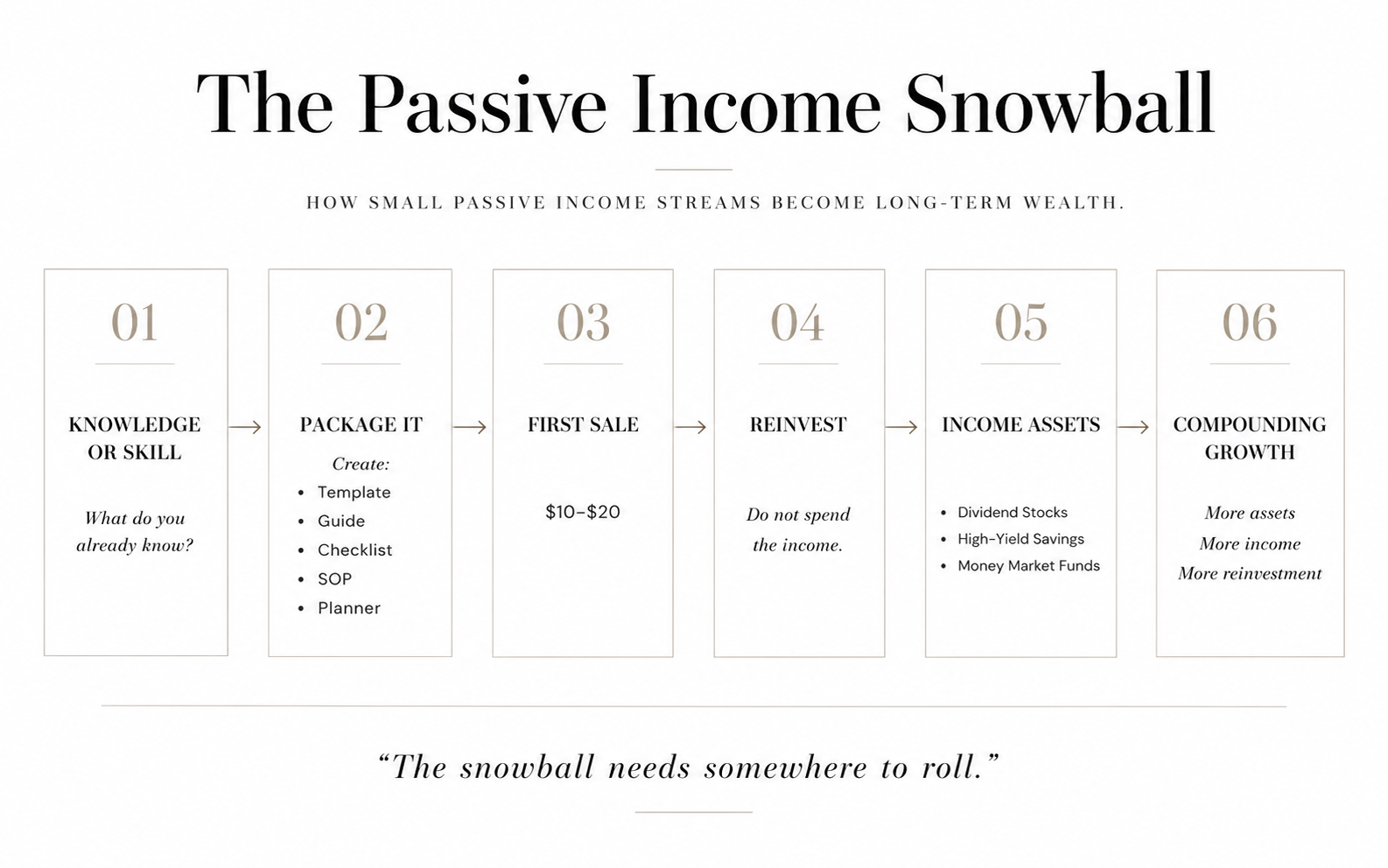
When the first sale comes in — and it will feel small, probably $10 or $20 — don't spend it.
I mean that literally. Park it somewhere it can grow: a high-yield savings account, a money market fund, or a fractional share of a dividend stock.
This sounds almost insultingly simple. But the discipline of treating passive income as an asset to reinvest rather than a bonus to spend is what separates people who build lasting financial independence from people who make a bit of extra money and stay stuck.
The snowball needs somewhere to roll.
The Honest Part Nobody Tells You
Passive income for beginners is often sold as the easy path. It isn't.
The passive part — income that arrives without your constant attention — only happens after the active part: creating something, listing it, promoting it enough to get initial traction, improving it, and repeating that process until the flywheel starts to spin on its own.
That active phase takes longer than most people expect. It also teaches you more than any course or guide can, including this one.
What I'd tell you from having done this: start simpler than you think you need to. Create one small product. Go through the whole process once, imperfectly. Make your first $10 in passive income and reinvest it.
The skill you build in that first cycle is worth more than the money. And the money starts to compound from there.
Ready to Go Deeper?
This post is Part 1 in the Passive Income for Beginners series. Here's where to go next:
Passive Income for Beginners: The Complete Guide — the hub post that covers all three buckets and the Passive Income Snowball strategy.
Part 2: How to Start a Digital Product Business as a Beginner — includes scaling ideas and digital product validation.
Part 3: How to Sell on Etsy for Beginners — learn how to turn Etsy into a lead generating machine for higher ticket services
Part 4: How to Build Multiple Passive Income Streams —learn how and when to add additional passive income streams.
If you want the full strategy in one place, the Passive Income Playbook and Digital Product Playbook cover everything in depth — including the Snowball Tracker and the paid lead magnet framework for coaches.
Grab my free High Ticket Coach Branding Guide
A free guide for coaches, consultants, and creators who are ready to ditch the DIY look and step into a cohesive, premium brand presence that sells.
We hate SPAM. We will never sell your information, for any reason.