How to Sell on Etsy for Beginners: Your First Passive Income Stream
Jun 12, 2026
I was sitting in a mastermind session with some of the most successful coaches and course creators in the industry when someone said something that stopped me cold.
She mentioned, almost as an aside, that she had been generating $6,000 a month in passive income by putting her existing lead magnets on Etsy.
Not a new product line. Not a complex funnel. Her existing lead magnets — things she had already created — listed on Etsy, quietly selling to buyers she had never met and never marketed to directly.
I remember the exact feeling. Equal parts shock and curiosity. This was inside Amy Porterfield's Momentum Mastermind, a room full of people who knew their stuff, and this concept landed on me differently than anything else discussed that day.
I went home and did the same thing.
I took some lead magnets I had created for an old LinkedIn course — content that already existed, already done — and listed them on Etsy. The first sale notification came through on my phone and I felt something I wasn't expecting: proof. Not just that Etsy worked, but that passive income from digital products was more accessible than I had realized.
That first pivot eventually led me to where I am now — selling Canva and Kajabi templates to coaches and course creators, solving a problem I understood deeply because I had lived it myself. But it started with someone else's $6,000 month and the decision to find out if it was real.
It is.
Why Etsy Works for Beginners
Most passive income advice has a hidden assumption buried inside it: that you already have an audience.
Build a course — but who will buy it? Start a blog — but who will read it? Create a digital product — but where will you sell it?
Etsy removes that assumption entirely. It is one of the few platforms where a brand new seller with zero followers, zero email subscribers, and zero existing traffic can list a product today and make a sale this week — because Etsy brings the buyers to you.
With over 90 million active buyers on the platform, Etsy has built-in search traffic that functions like its own version of Google. People go to Etsy specifically to find and buy things. Your job as a new seller is not to drive traffic — it's to show up correctly when buyers are already searching for what you're selling.
That changes the math for beginners significantly.
Compared to selling from your own website, where traffic depends entirely on your SEO, your social following, or your paid ads budget, Etsy gives you a running start. You are listing inside a marketplace that already has momentum.
There are trade-offs. Etsy takes a percentage of each sale. You have limited control over the customer relationship after purchase. The platform can and does change its algorithms and fee structures. These are real limitations worth knowing about.
But for a first digital product — especially for someone with no existing audience — the traffic advantage outweighs all of those limitations. Get your first sales on Etsy. Build your confidence and your product line. Use that income and those early customers to fund the next stage of your business.
What Sells on Etsy as a Digital Product
Etsy started as a marketplace for handmade and vintage goods, but the digital product category has grown into one of its strongest performing areas. Buyers on Etsy are comfortable purchasing downloadable files — they know how it works, they trust the platform, and they are actively looking for things to buy.
The digital products that sell consistently on Etsy share a few common characteristics: they solve a specific problem, they deliver clear and immediate value, and they are easy for the buyer to use without hand-holding.
The strongest categories for beginners include:
PDF guides and ebooks on specific, practical topics. Not broad overviews — focused, actionable content that answers one question clearly.
Checklists, cheat sheets, and quick-reference documents. Buyers pay for shortcuts. If you can condense something complex into a one-page reference, that has real value.
Planners, trackers, and workbooks. Anything that helps someone organize, plan, or track something they already want to do.
Canva templates. Social media templates, presentation decks, brand kits, lead magnet templates, pitch decks — anything designed in Canva that a buyer can purchase, customize, and use immediately.
Notion templates. Dashboards, content planners, client management systems, project trackers. Increasingly popular and commanding solid price points.
Spreadsheet templates. Financial trackers, budget planners, business dashboards. High perceived value, especially in business and productivity niches.
The pattern across all of these: specific, practical, immediately usable. Etsy buyers are not browsing for inspiration. They are looking for something that solves a problem they already have.
A Specific Opportunity for Coaches and Course Creators
If you're a coach, consultant, or course creator, Etsy represents something beyond a passive income channel. It's a client acquisition tool that pays you.
Here's the dynamic I've seen play out repeatedly — in my own business and in the businesses of coaches I've worked with.
Most coaches rely on content marketing, referrals, or paid ads to attract potential clients. Those channels work, but they all share the same limitation: the people they attract are at different stages of readiness. Some are ready to invest in a high-ticket offer. Most are not — at least not yet.
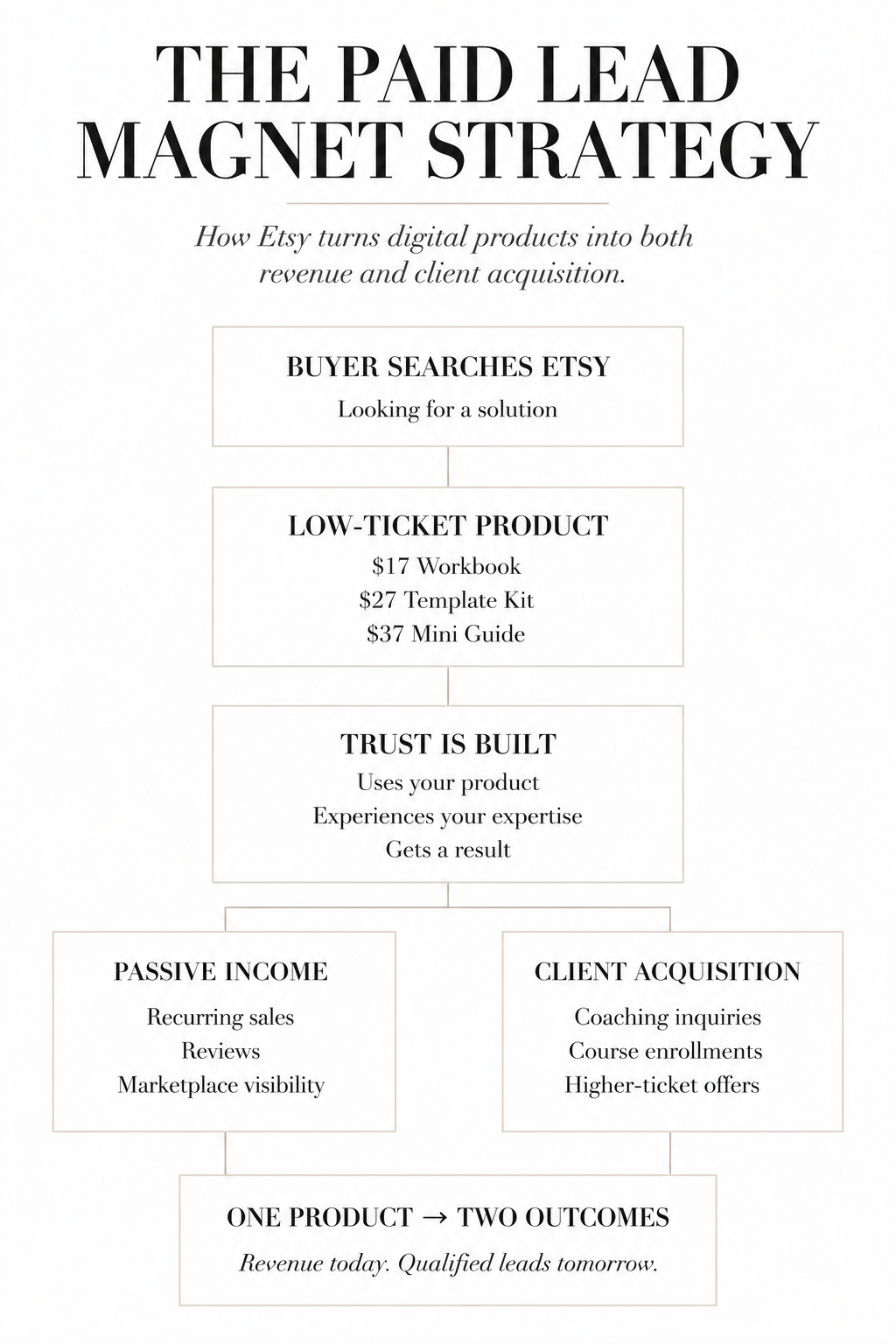
A low-ticket digital product on Etsy — a $17 workbook, a $27 template kit, a $37 mini-guide — acts as what I call a paid lead magnet. It sits at the entry point of your offer ecosystem. Someone finds it on Etsy while searching for something specific, buys it because the price is accessible, and experiences the quality of your thinking firsthand.
By the time they reach out about your coaching program or your course, the trust is already partially built. They've paid you something. They've used something you created. They have evidence of what working with you produces.
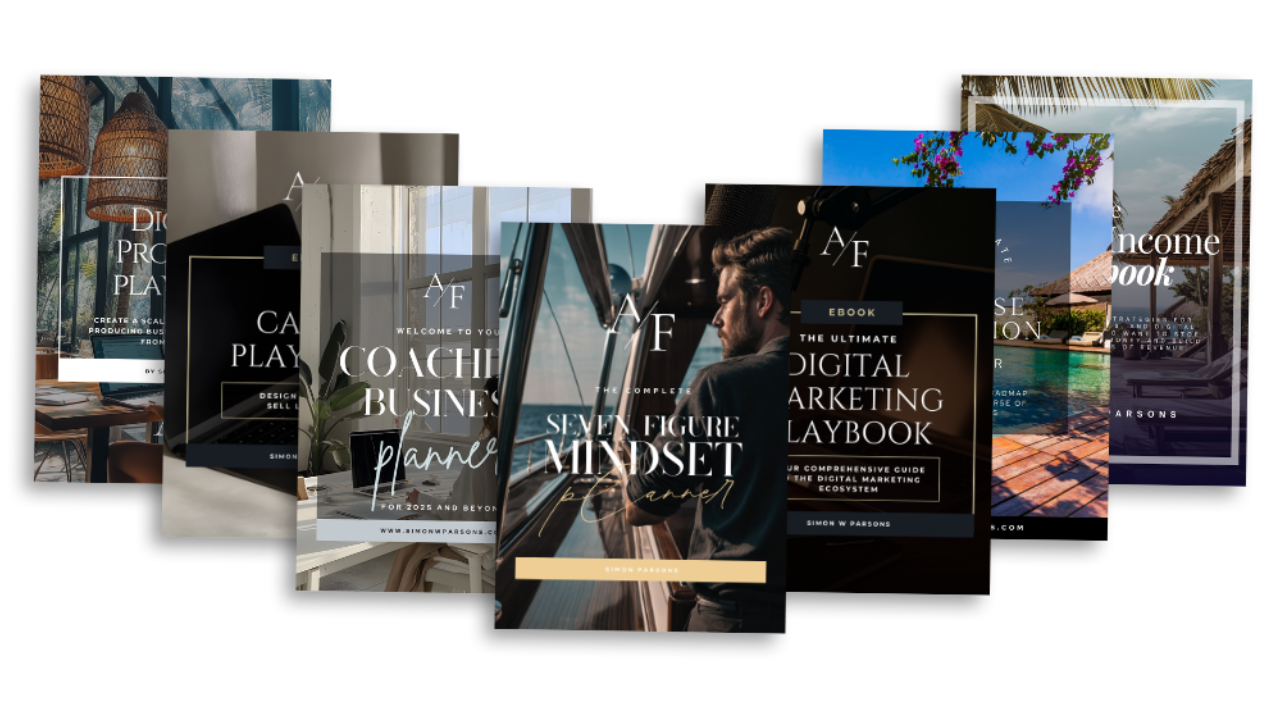
I built a full chapter around this strategy in the Etsy Digital Product Playbook because the mechanics matter — how you price a paid lead magnet, how you position it relative to your higher-ticket offers, how you structure the listing to attract the right buyer. Done correctly, one well-positioned Etsy product can generate passive income and warm leads simultaneously.
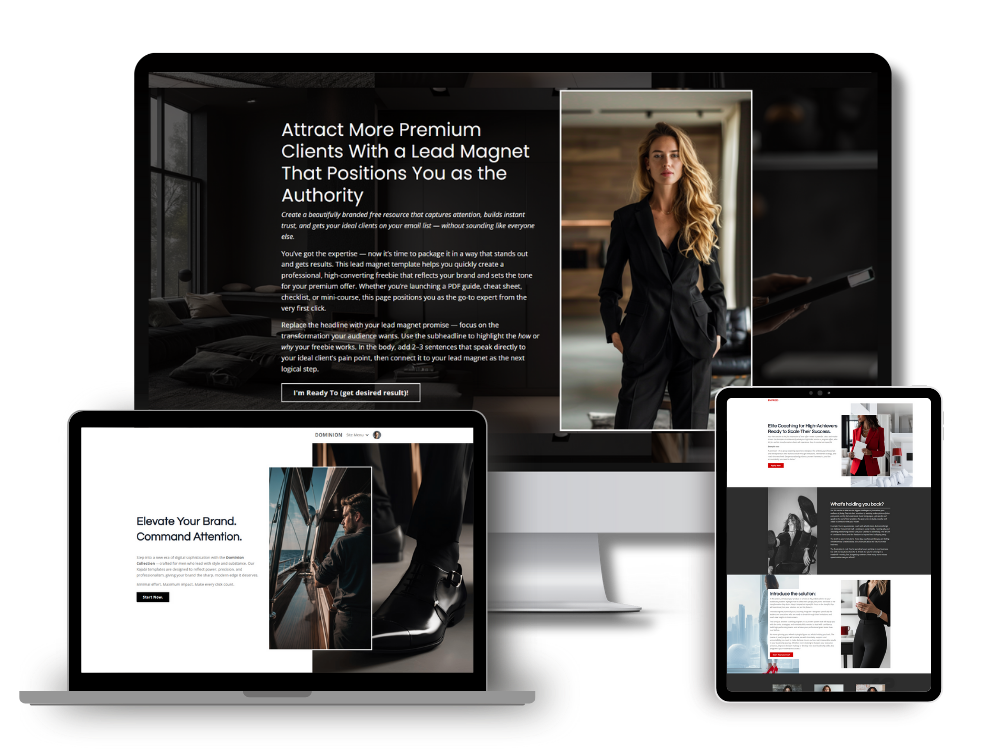
If you are a coach who has ever created a lead magnet — a free guide, a checklist, a resource you give away to build your list — you already have the raw material for your first Etsy product. You may just need to package it properly and put a price on it.
Setting Up Your Etsy Shop: What Actually Matters
The technical setup of an Etsy shop is genuinely straightforward. Etsy walks you through it step by step and the process takes an afternoon, not a week.
What matters more than the mechanics is the decisions you make during setup — because some of them affect how your shop appears in search and how buyers perceive your brand before they ever click on a listing.
Your shop name. Choose something that signals what you sell and who it's for. It doesn't need to be clever. It needs to be clear. A coach selling business templates benefits more from a name like "CoachTemplateStudio" than something abstract that means nothing to a first-time visitor.
Your shop banner and profile. Etsy is a visual platform. Buyers make split-second decisions about whether a shop looks credible and professional before they look at individual listings. A clean, well-designed banner that reflects your brand positioning matters. This is an area where Canva makes it easy to create something that looks intentional without hiring a designer.
Your shop policies. Digital products have specific delivery and refund considerations. Set clear policies upfront. Etsy has standard templates for this — use them and customize as needed. Clear policies reduce disputes and build buyer confidence.
Your About section. People buy from people, even on a marketplace platform. A brief, genuine About section that explains who you are and what you create gives your shop a human element that generic shops lack. Keep it short and specific.
Creating a Listing That Converts
Your listing is where the sale is won or lost. Everything about the listing — the thumbnail image, the title, the description, the preview images — works together to answer one question in the buyer's mind: is this worth my money?
The thumbnail image is everything. On Etsy, buyers scroll through a grid of results. Your thumbnail has a fraction of a second to earn a click. It needs to be visually clean, clearly communicate what the product is, and look professional enough to justify the price. For digital products, mockup images — showing the product displayed on a device or in context — consistently outperform flat screenshots.
The title should describe what the product does, not just what it is. "Canva Social Media Templates for Coaches" outperforms "Social Media Pack" because it tells the buyer exactly what they're getting and who it's for. Specificity earns clicks from the right buyers and filters out the wrong ones.
The description should answer the questions a buyer has before they ask them. What's included? What format is it delivered in? What do they need to use it? How do they access it after purchase? A clear, well-organized description reduces friction and increases conversion.
Preview images tell the full story. Etsy allows multiple images per listing. Use them. Show different angles, different pages, different use cases. Buyers of digital products can't hold the thing before buying — your images are doing the work of a physical product experience.
Pricing Your Digital Products on Etsy
Pricing on Etsy requires balancing two things: being competitive enough that buyers don't immediately move on, and being priced high enough that your product is taken seriously.
A $1 digital product signals low quality regardless of what's inside it. A $200 digital product from an unknown shop with no reviews is a hard sell. The sweet spot for most beginners is between $7 and $47 depending on the complexity and depth of what you're offering.
Simple, focused products — a single checklist, a one-page reference guide, a basic template — sit naturally in the $7-17 range. More comprehensive products — multi-page workbooks, full template kits, detailed SOPs — can comfortably sit between $27 and $47. Bundled collections or premium products with clear, high-value outcomes can go higher once you have reviews and social proof behind them.
One principle worth holding onto: price based on the value delivered, not the time it took you to create it. A one-page cheat sheet that saves a buyer three hours of research is worth more than a 40-page guide they'll never finish reading.
What to Expect in the Beginning
The first few weeks on Etsy will likely be quiet. That's normal and it's not a signal that something is wrong.
New shops have no reviews, no sales history, and no established position in Etsy's search algorithm. The platform favors shops with proven track records, which means new sellers are starting at the back of the line. Getting those first few sales — and the reviews that come with them — is the priority in the early stage, not volume.
A few things that accelerate the early phase: listing multiple products rather than just one, using all available listing slots, pricing competitively while you build initial reviews, and promoting your Etsy shop through whatever platform you already have — even a small social following or email list can generate the first handful of sales that get the algorithm moving.
Patience here is not optional. The sellers who build meaningful passive income on Etsy are almost never the ones who saw explosive results in month one. They are the ones who kept listing, kept improving, and let the compounding do its work.
How Etsy Fits Into a Bigger Passive Income Strategy
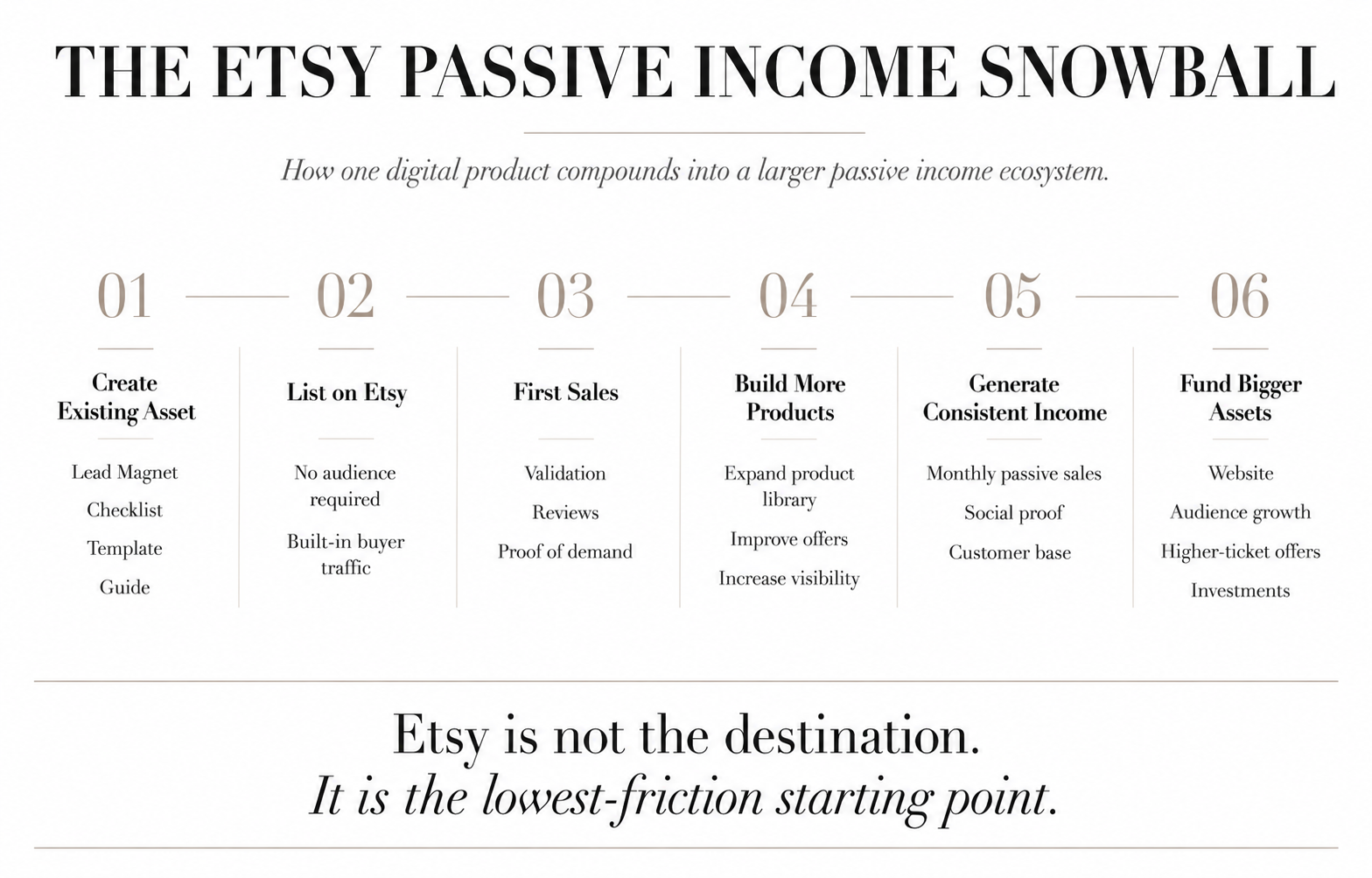
Etsy is a starting point, not a destination.
The goal is to use Etsy's built-in traffic to validate your products, generate your first passive income, and build the customer base and social proof that makes everything else easier — including selling from your own website, building a higher-ticket offer ecosystem, and eventually having enough passive income to reinvest into Bucket One assets.
This is the sequence I'd follow if I were starting over: create a digital product, list it on Etsy, use the sales and feedback to improve it and build the next one, use that income to start funding investments, and grow an audience in parallel that eventually drives traffic to your own platform.
Etsy fits into that sequence as the lowest-friction first step — the place where you make your first sale without needing an audience, validate that people will pay for what you've created, and start the Passive Income Snowball rolling.
The Passive Income for Beginners guide covers how Etsy fits within the full three-bucket strategy and the snowball framework in detail.
Ready to Go Deeper?
This is Part 3 of the Passive Income for Beginners series.
Passive Income for Beginners: The Complete Guide — the hub post covering all three income buckets and the Passive Income Snowball.
Best Passive Income Ideas for Beginners with No Experience — Part 1, the full tiered list of where to start.
How to Start a Digital Product Business as a Beginner — Part 2, the full roadmap for building and selling your first digital product.
Part 4: How to Build Multiple Passive Income Streams — learn when to scale and start adding additional streams of passive income.
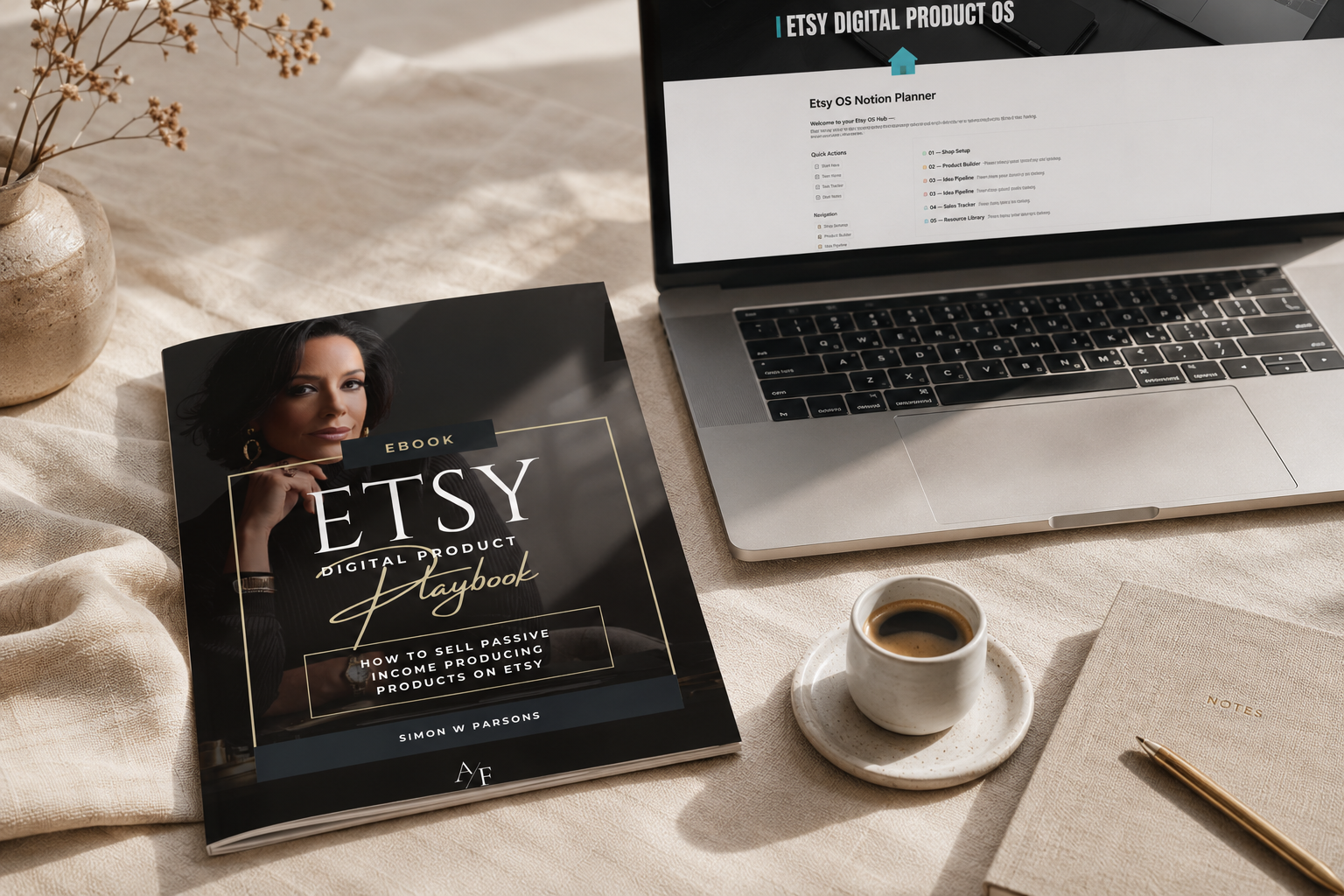
For the complete Etsy strategy — including shop setup, listing optimization, Etsy SEO, and the paid lead magnet framework for coaches — the Etsy Digital Product Playbook covers all of it in depth. The Passive Income Playbook covers the broader system these Etsy sales feed into.
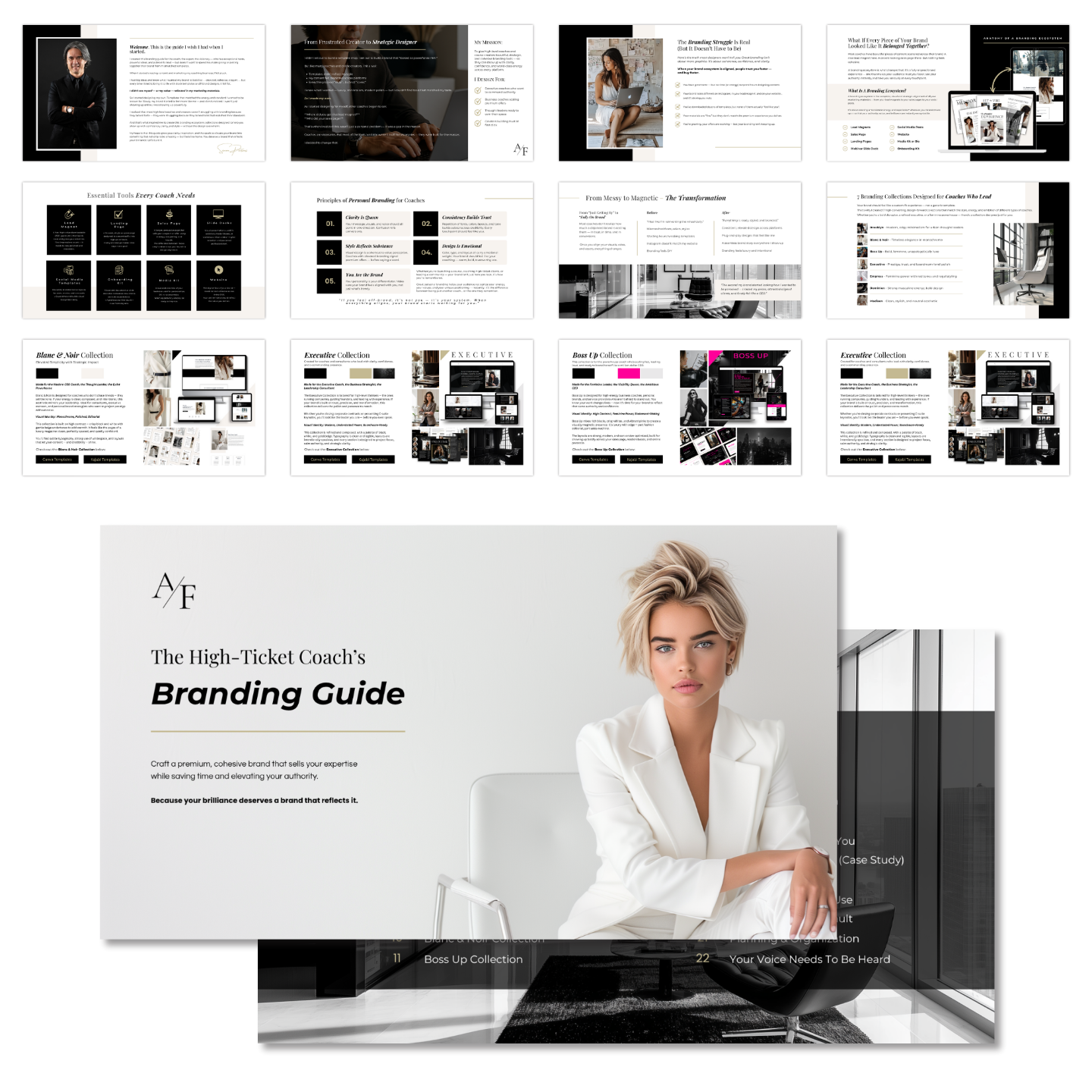
Grab my free High Ticket Coach Branding Guide
A free guide for coaches, consultants, and creators who are ready to ditch the DIY look and step into a cohesive, premium brand presence that sells.
We hate SPAM. We will never sell your information, for any reason.