Passive Income For Beginners: What It Really Takes
Jun 01, 2026
A lot of coaches and creators ask me the same question: how do I make money when I'm not working?
It's a good question. And it's one I spent years figuring out the hard way — starting at 41, making a multiple six-figure income, and realizing the math still didn't work the way I'd been told it would.
This post is the honest answer. Not the Instagram version. The real one.
I'm going to walk you through what passive income actually is, the three main ways to build it, a strategy I call the Passive Income Snowball, and how to pick your first stream if you're starting from zero.
This is also the starting point for a four-part series. If you want to go deep on any one area, the individual posts have you covered. But start here first.
What Passive Income Actually Means (And What It Doesn't)
The phrase "passive income" gets used to sell a fantasy. The fantasy goes: set something up once, forget about it, and watch money roll in while you sleep. No work. No effort. Basically a money tap.
That's not what passive income is.
The real definition: passive income is income that requires an initial investment of time, money, or both — with little to no ongoing effort once that asset is built or acquired.
The key phrase is initial investment. Every legitimate passive income stream costs you something upfront — either capital you put in, or hours you put in to create something. The payoff comes on the back end, when that asset keeps generating returns without requiring your constant attention.
This distinction matters because it changes how you approach building these streams. You're not looking for shortcuts. You're looking for things worth building.
When I started this journey, I had to let go of the idea that passive income was going to be fast. It wasn't. The first five years were slow, consistent, and occasionally frustrating. The compounding happened later. That's how it works for almost everyone — including people who now look like overnight successes.
The Three Buckets of Passive Income
There are dozens of passive income strategies out there, but almost all of them fall into one of three categories. Understanding which bucket something belongs to helps you decide what makes sense for your situation right now.
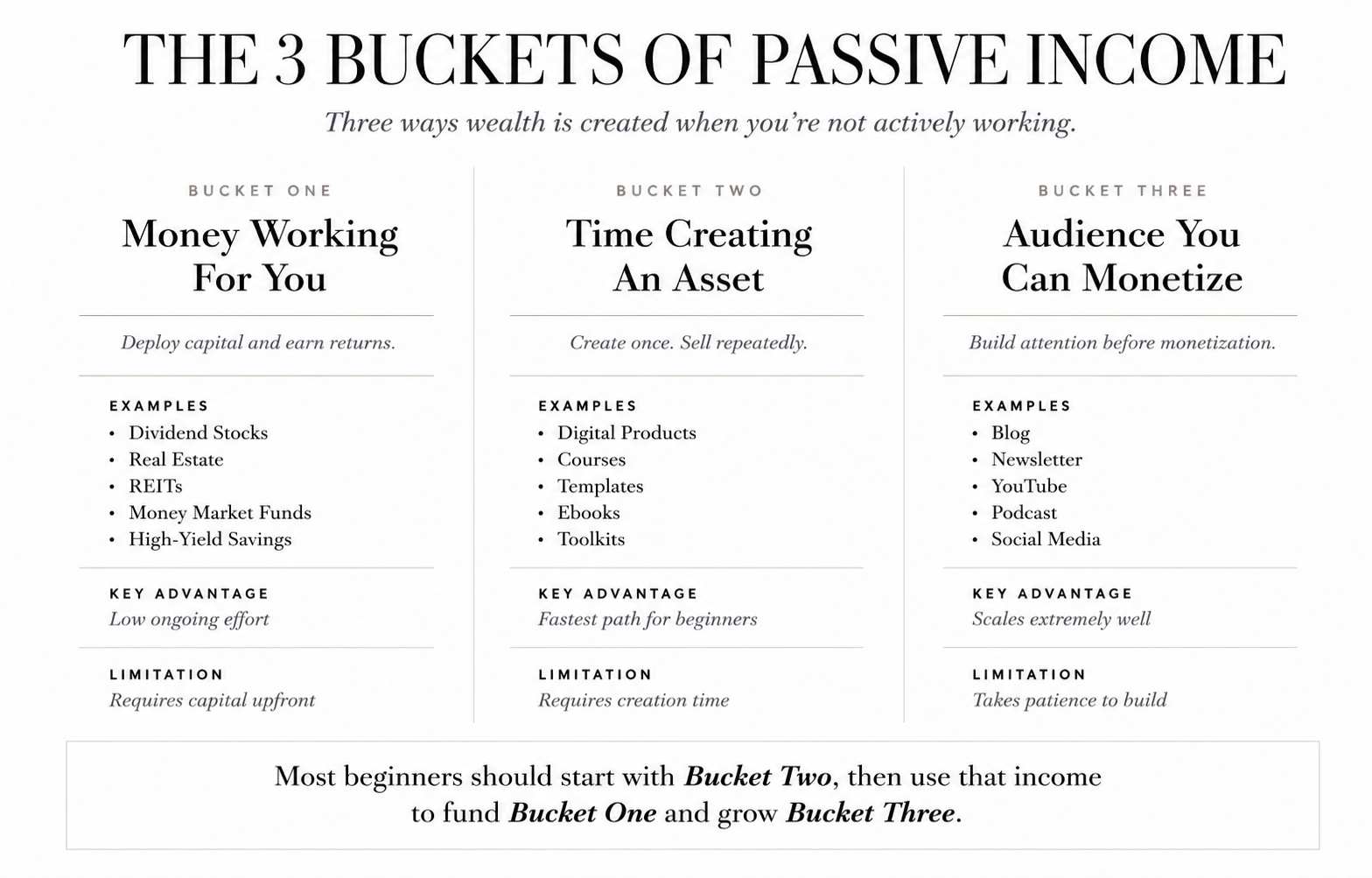
Bucket One: Money Working for You
This is the most traditional form of passive income, and it's exactly what it sounds like: you deploy capital, and that capital generates returns.
Examples include dividend-paying stocks, real estate, peer-to-peer lending, high-yield savings accounts, money market funds, and REITs.
The upside is that once the capital is deployed, it's genuinely low-effort. A dividend stock doesn't require you to show up every day.
The obvious limitation is that you need money to make money. A 5% dividend on $1,000 is $50 a year. On $100,000 it's $5,000. The math works — it just takes capital to get there.
This is where I started. I was putting an extra $100 a month into dividend stocks and watching it crawl forward. It took five years to get to $4,000 per year. That's not nothing, but it wasn't going to change my life on its own.
If you have capital to deploy, Bucket One is solid and worth building over time. If you don't have capital yet, you need to start with Bucket Two.
Bucket Two: Time Creating an Asset
This is where things get interesting — especially for coaches, creators, and anyone with skills or knowledge to share.
Instead of deploying money, you deploy time. You create something once, and that thing keeps generating income long after you've stopped working on it.
Digital products are the clearest example: templates, ebooks, courses, checklists, SOPs, apps, presets, toolkits. You build it, you put it up for sale, and it keeps selling without you having to fulfill anything manually.
I moved into this bucket when I started creating online courses — my first real "one to many" income model instead of trading hours for dollars. Later that evolved into templates and downloadable products.
The shift in velocity was dramatic. It took me five years of buying dividend stocks to hit $4,000 per year in passive income. Digital products got me to $4,000-5,000 per month in about two years.
Same destination. Wildly different timeline.
That's the power of Bucket Two for anyone who doesn't have large amounts of capital to invest upfront. You're leveraging your knowledge and creativity instead of your savings.
The initial investment is real — it takes time to create a quality product, to set up your systems, to find where your buyers are. But once it's built, the ongoing work drops significantly.
If you're a coach, creator, or service provider sitting on expertise, this is almost certainly where you should start.
Bucket Three: An Audience You Can Monetize
The third bucket is about building an audience first, then monetizing that attention through partnerships, sponsorships, affiliate income, or joint ventures.
This one requires the most patience. Building a genuine audience — through a blog, newsletter, YouTube channel, podcast, or social platform — takes time and consistency. There's no shortcut, and anyone who tells you otherwise is selling something.
But the economics at scale are remarkable. A newsletter with 10,000 engaged subscribers, or a YouTube channel with a loyal niche audience, can generate substantial income through affiliate commissions, brand deals, or promoting your own products.
My affiliate income through programs like the Kajabi Partner Program is a direct result of the audience I've built around templates and digital products. It didn't happen quickly, but it now runs with very little ongoing effort beyond the content I was already creating.
Bucket Three is often the slowest to start but the hardest to replicate once you have it. If you're already creating content consistently, you're further along than you think.
The Passive Income Snowball
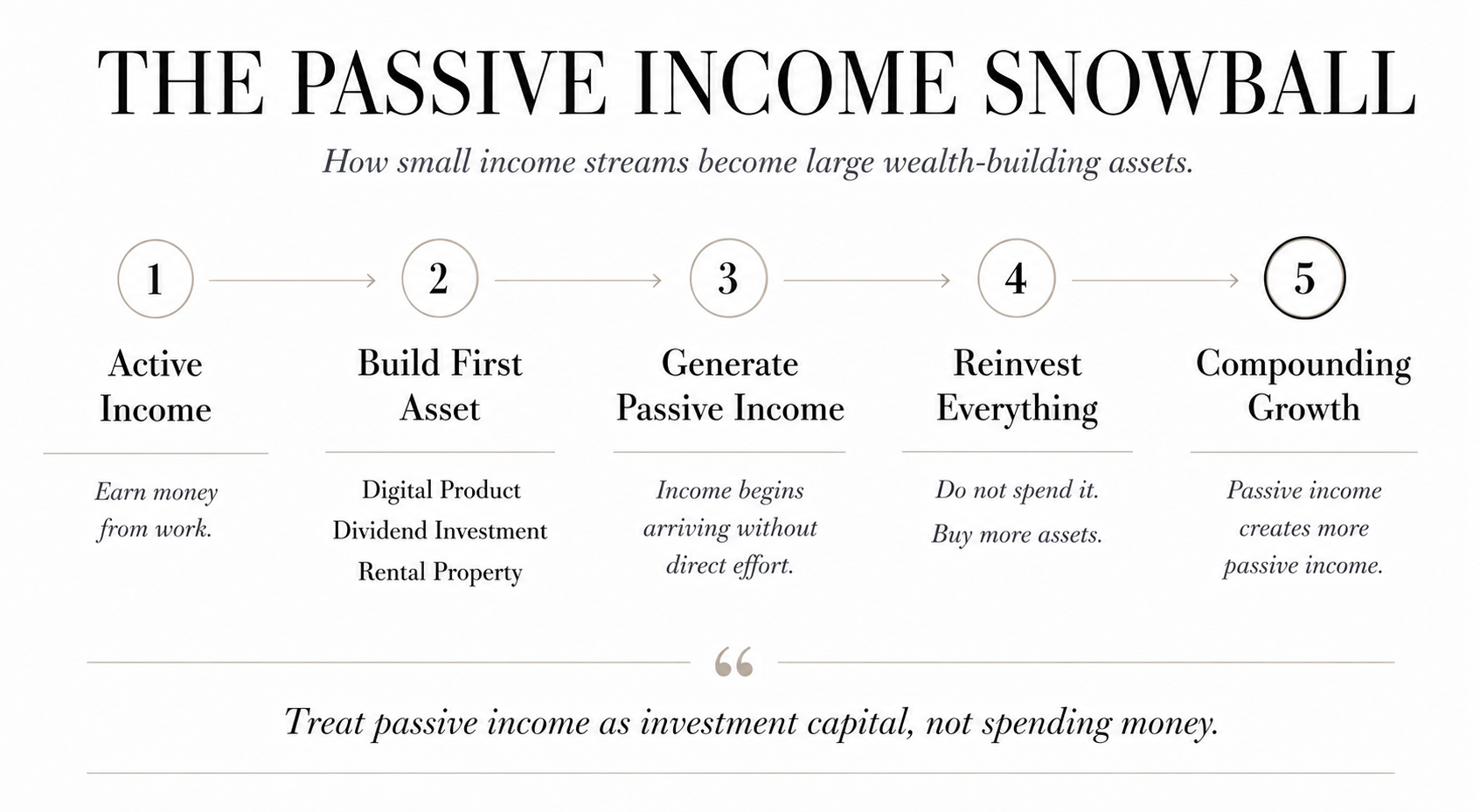
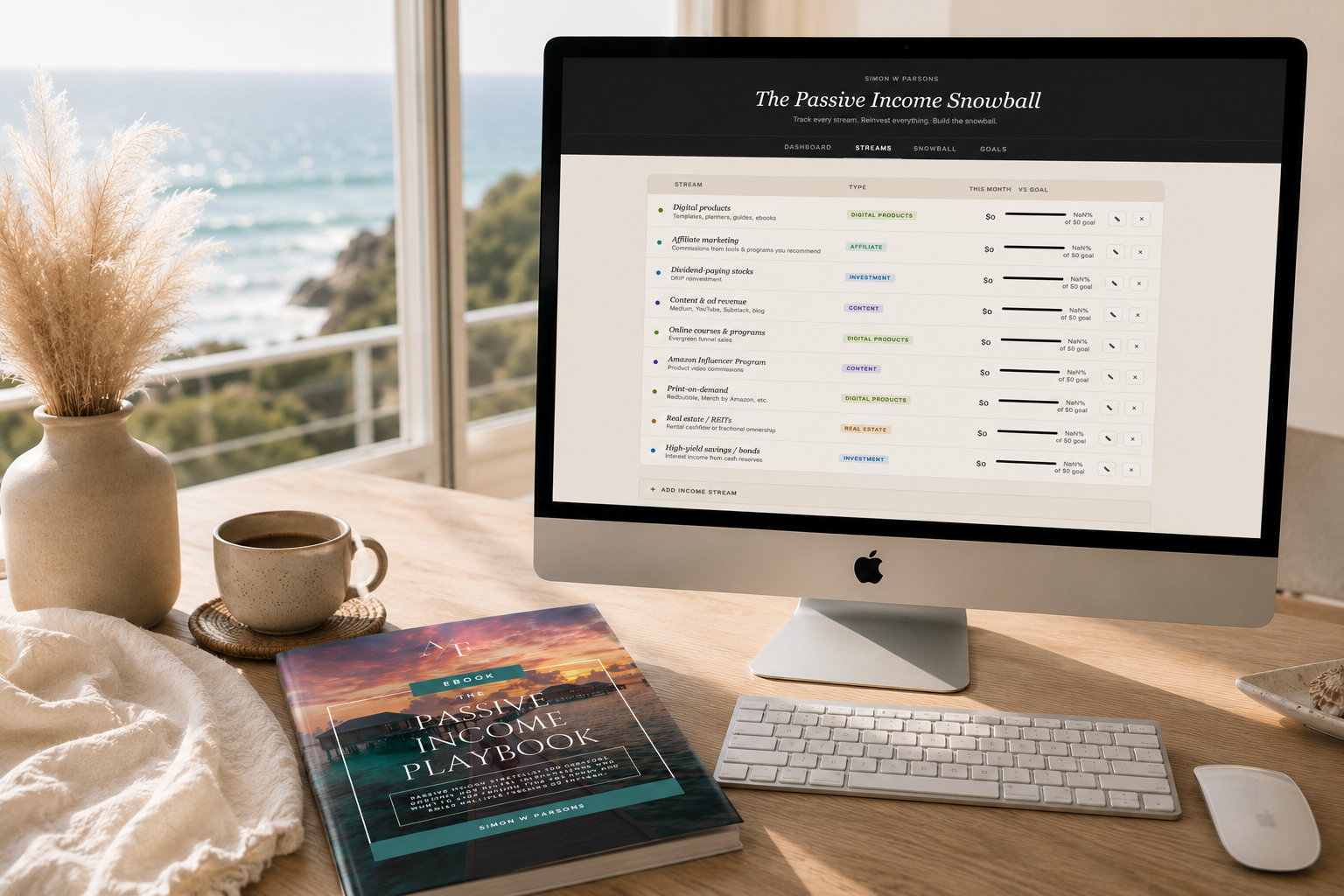
This is the strategy I talk about in my Passive Income Playbook, and it's the concept that changed how I think about building wealth.
You've probably heard of Dave Ramsey's Debt Snowball — the approach where you list your debts smallest to largest and pay them off in order, building momentum as each one disappears. It's a smart psychological and financial strategy for getting out of debt.
The Passive Income Snowball works on the same principle, but in reverse. Instead of eliminating liabilities, you're building assets.
Here's how it works: whatever passive income you generate, you don't spend it. You take that income and use it to acquire more cash-flowing assets — dividend stocks, a savings account, a rental property, more digital products. Your passive income creates more passive income. The snowball gets bigger as it rolls.
The discipline required is real. It means living off your active income and treating your passive income as sacred — money that only goes toward building more assets. That's hard when the passive income starts to feel like "extra" spending money.
But the compounding effect is what makes this powerful. A $500/month digital product income that gets reinvested starts to look very different in three years than $500/month spent on dinners and vacations.
I started with dividend stocks, moved into real estate, then added digital products and affiliate income. Looking back, I would have started with digital products — they're accessible, low-cost to create, and can generate returns fast enough to fuel everything else. I just didn't understand them the way I do now.
Today my passive income ecosystem includes digital product sales, affiliate commissions, dividends, and rental income — all reinvested and compounding. The snowball is still rolling.
Where Most Beginners Go Wrong
Two patterns come up again and again for people starting out with passive income.
The first is waiting until they have the perfect product, the perfect platform, or the perfect plan. Passive income doesn't reward perfectionism. It rewards iteration. Your first digital product does not need to be your magnum opus — it needs to exist, go out into the world, and teach you something.
The second is treating early passive income as a bonus to spend rather than an asset to deploy. The moment you start spending passive income on lifestyle instead of reinvesting it, you break the snowball. The compounding stops. You're back to trading time for money, just with an extra step.
Neither of these is fatal. But catching them early saves a lot of time.
How to Choose Your First Stream
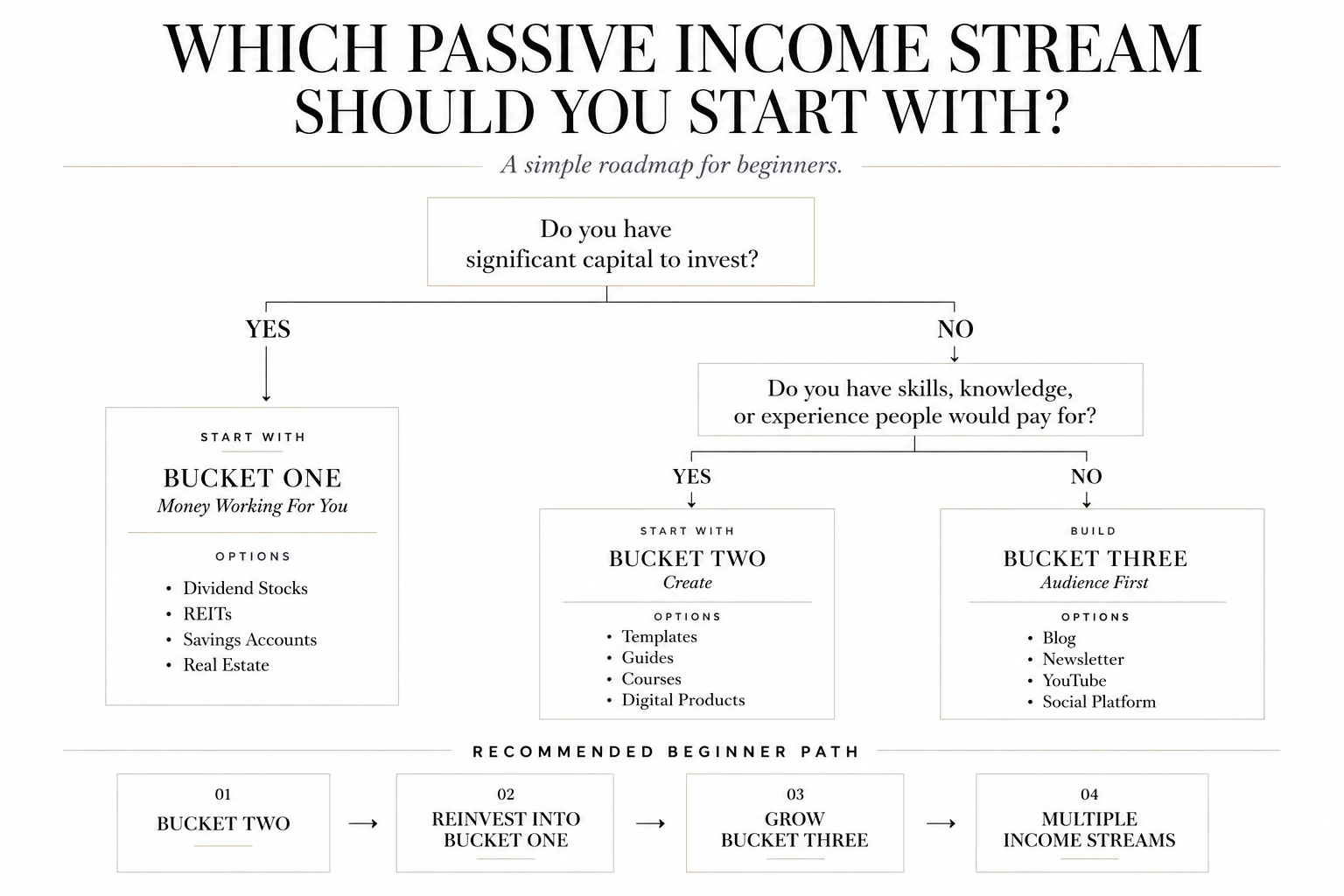
If you're starting with no capital and no existing audience, Bucket Two is almost always the right place to start.
Here's a simple way to think about it: what do you already know that someone else would pay to have explained, organized, or templated?
You don't need to build a full course. A well-designed PDF guide or a useful template can sell consistently on platforms like Etsy for months and years without you touching it. That $10-50/month in early income isn't the point — going through the process of building, listing, and selling something is the point. That's the skill.
Once you've done it once, the second product is faster. The third is faster still. The compounding starts with the knowledge, before it ever starts with the money.
When that first bit of passive income starts coming in, don't spend it. Park it in a high-yield savings account. That's Bucket One. You've just started the snowball.
What Comes Next: The Full Passive Income Series
This post is the overview. The four articles that follow each go deeper on one area:
Part 1: Best Passive Income Ideas for Beginners with No Experience For anyone who wants a concrete list of where to start, filtered for people who don't have capital or an existing audience.
Part 2: How to Start a Digital Product Business as a Beginner The full picture on Bucket Two — what to create, where to sell it, and how to set up systems that let it run without you.
Part 3: How to Sell on Etsy for Beginners A step-by-step look at Etsy as a passive income channel, from listing your first product to understanding what makes things sell.
Part 4: How to Build Multiple Passive Income Streams as a Beginner How to layer streams over time, when to add the next one, and how to use the Passive Income Snowball to make each stream fund the next.
If you want to shortcut the learning curve, the Passive Income Playbook covers the full strategy in one place — including the Snowball Tracker tool I built to help you log your streams and watch the compounding in real time.
The Passive Income Playbook also includes a bonus Passive Income Tracker to help you visualize and map out your success.
You can also find my work on Medium where I write exclusively about digital products, selling on Etsy and passive income. It's a behind the scenes look at how I actually built out the current form of my business.
The game is long, start simple and start now. This is one of those things that the future version of yourself will thank you for.
Simon
Grab my free High Ticket Coach Branding Guide
A free guide for coaches, consultants, and creators who are ready to ditch the DIY look and step into a cohesive, premium brand presence that sells.
We hate SPAM. We will never sell your information, for any reason.