
Kajabi SEO: The Complete Guide for Coaches
Jun 21, 2026
When I started my first online business back in 2005, it was the early days of Google search and I was easily able to rank at the top of the search engines and generate business.
Back then it was the only way I knew how to generate traffic to my website and before the rise of social media, Pinteest, YouTube and email marketing.
When I came back into the online space in 2020 as a coach and course creator, I had forgotten about the strong results I had gotten from SEO and was more focused on the endless hours spend creating content on social media platforms (in my case it was LinkedIn).
A few years ago I realized that I needed to get back to my SEO roots and start thinking about how I could ditch social media and drive SEO traffic to my Kajabi website.
These days I'm happy to say that I've completely removed myself from promoting on social media and only generate traffic through SEO (either directly to my Kajabi site or from the Etsy marketplace).
I think a lot of coaches and course creators don't think a lot about proper SEO when using Kajabi, but done right it can generate substantial leads and clients to you.
The best part is it doesn't take a lot of extra work, just some planning for how you lay out your Kajabi website and assets. If you already have an established Kajabi website, you can simply revise your pages to start generating more traffic from search engines.
The thing to keep in mind, if people find you through search, they are likely to be 'high intent buyers' and not just random people that find you in a social media algorithm.
To put it bluntly - SEO is the best source of traffic that you can get.
Why Most Kajabi Sites Don't Rank
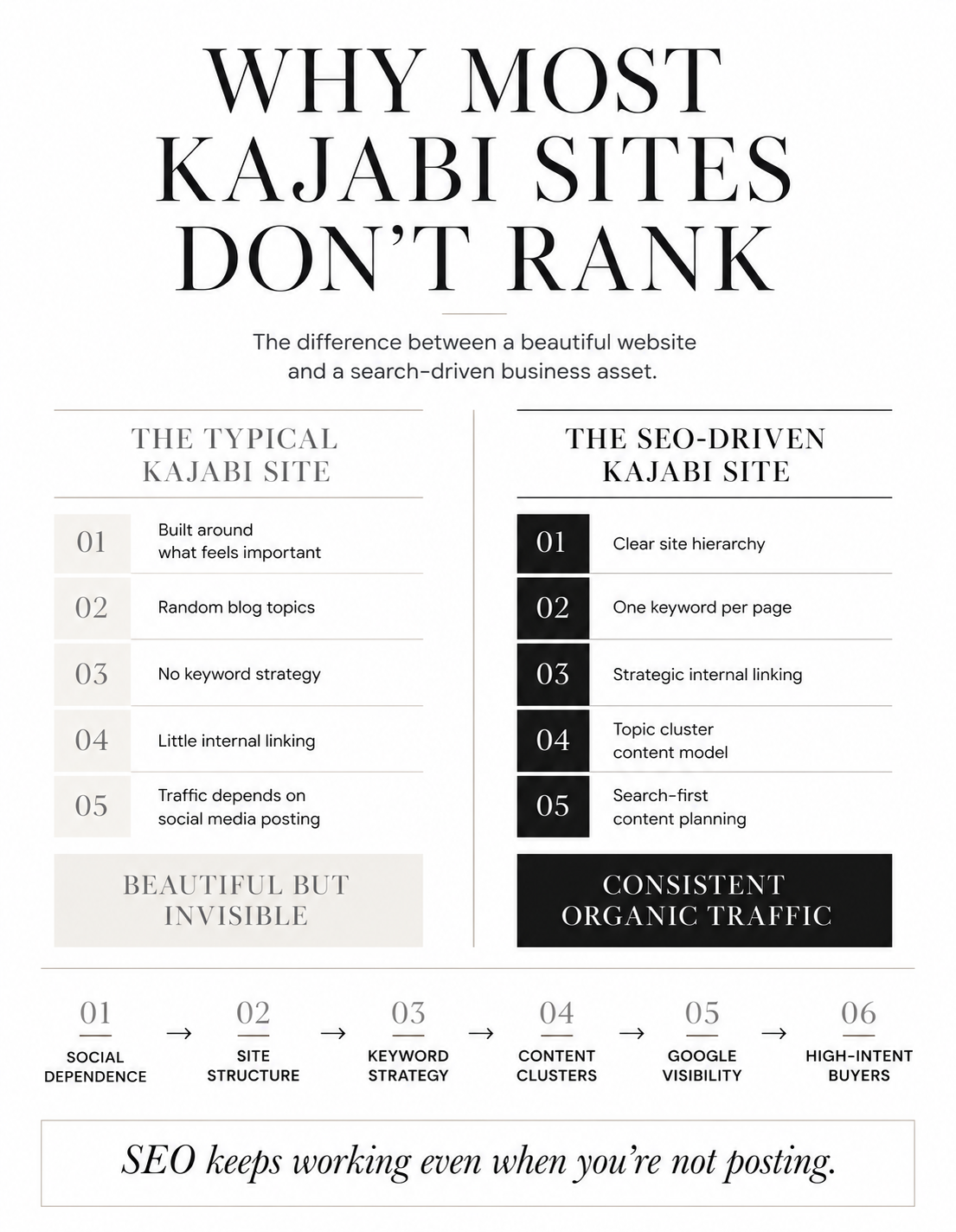
Here's what nobody tells you when you sign up for Kajabi: the platform gives you the tools, but it doesn't structure your site for you.
Most coaches publish a homepage, a few program pages, maybe a sales page, and call it done — without ever stopping to fix the kajabi website design mistakes that are quietly costing them. There's no deliberate keyword strategy behind any of it. Pages get built around what feels important that week, not around what your ideal client is actually typing into Google.
Then six months later you add a blog. The posts are scattered. One is about mindset, the next is about pricing, the next is a personal update. There's no thread connecting them, so Google has no reason to see your site as an authority on anything in particular.
Add to that a heavy reliance on Instagram or email for all your visibility, and you end up with a beautiful site that depends entirely on you showing up every single day to get any traffic at all. The moment you stop posting, the visibility stops too.
A lot of this comes back to never having a clear plan for the site in the first place. If that sounds familiar, it's worth going back to basics with Kajabi Templates: The Complete Guide for Coaches & Course Creators before tackling SEO on top of a foundation that isn't solid yet.
Kajabi SEO fixes that. Done right, your website keeps working for you even on the weeks you don't post.
Does Kajabi Actually Support SEO? (Yes — Here's What It Gives You)
I get asked this constantly, usually by someone who's been told Kajabi is "bad for SEO." It isn't. The platform gives you everything you technically need.
Every page and blog post has its own editable title tag and meta description. URLs are customizable. Kajabi auto-generates a sitemap for your core website pages. Heading tags are built into the editor, so you can structure H1s, H2s, and H3s properly.
What Kajabi doesn't do is make those decisions for you. It hands you the tools and assumes you know how to use them. That gap, between having the tools and knowing how to structure a site with them, is where most coaches get stuck.
One thing worth flagging early: Kajabi's auto-generated sitemap typically covers your website pages, but custom landing pages and product pages aren't always included automatically. If you're building standalone sales pages outside your main site navigation, don't assume Google is finding them on its own.
The Real Difference Between a Pretty Kajabi Site and a Ranking One
I've looked at a lot of coaching websites at this point, and the gap is rarely about design quality. Plenty of beautifully designed sites get zero organic traffic.
The difference is intention.
A ranking site has a clear hierarchy. Every page exists for a reason and targets something specific. The blog isn't a junk drawer of whatever crossed your mind that week, it's a body of content built around the questions your future clients are actually asking. And the pages link to each other in a way that tells Google, and your reader, how everything connects.
A pretty site with none of that structure is essentially invisible. It might convert beautifully once someone lands on it. The problem is almost nobody's landing on it.
The Five Pillars of Kajabi SEO
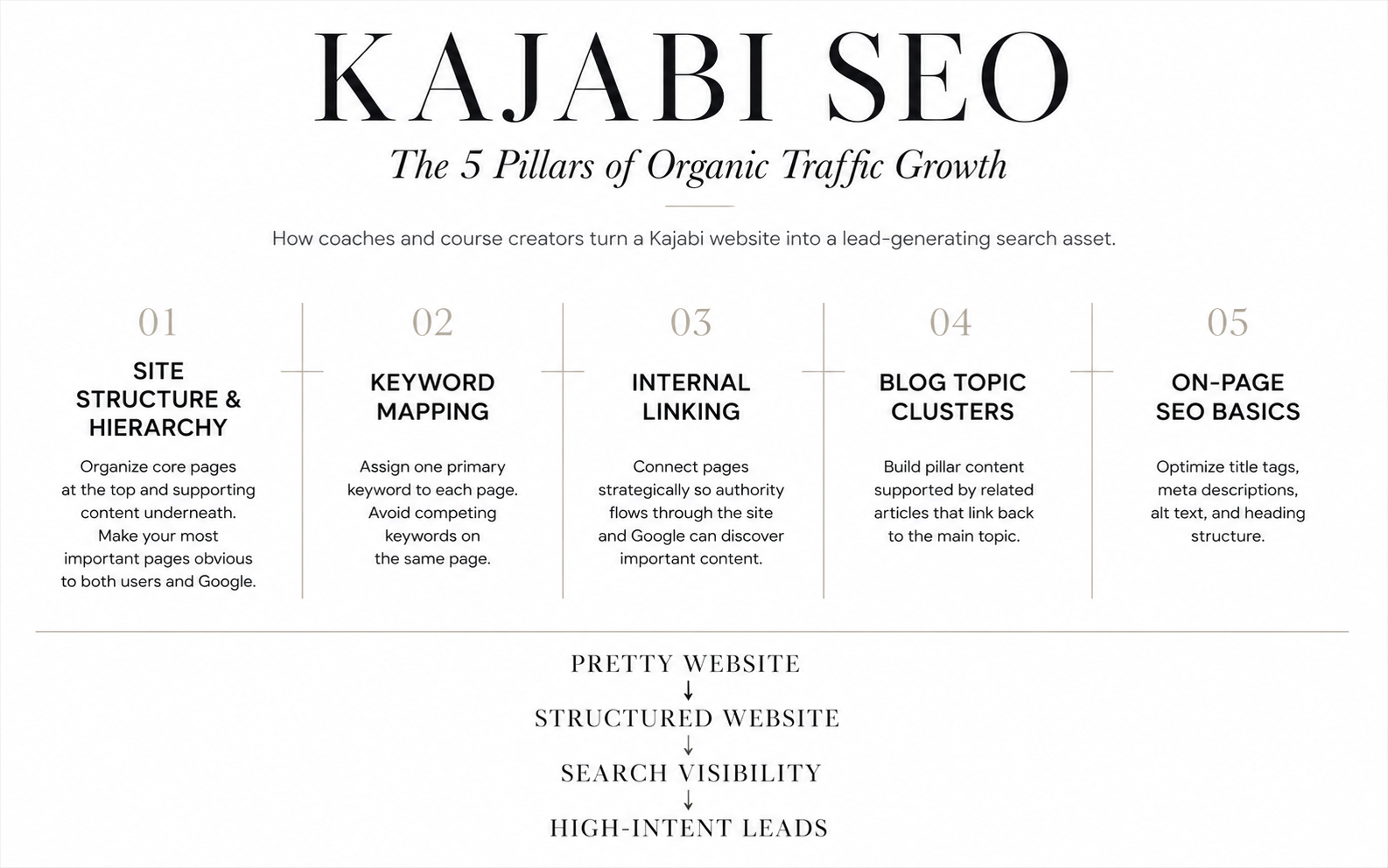
This is the framework I use on every Kajabi site I touch, including my own. I'll go deeper on each of these in separate posts, but here's the overview.
Site structure & hierarchy
Your site needs a clear map. Core pages (home, your main offer, your sales pages) sit at the top. Supporting content, like blog posts, sits underneath and points back up toward those core pages. If someone, or Google, can't tell what your most important pages are within a few seconds of landing on your site, the hierarchy isn't working.
Keyword mapping
Every page should be built around one primary keyword, not five competing ones. Trying to rank a single page for everything usually means it ranks for nothing. Map out what each page is actually for before you write a word of copy.
Internal linking
This matters more on Kajabi than on most platforms because of that sitemap limitation I mentioned earlier. If a page isn't being found through your sitemap, internal links are often how Google discovers it at all. Every blog post should link to at least one other relevant page on your site.
Blog topic clusters
Random posts don't build authority. A cluster does. Pick a core topic, like this one, write a pillar post that covers it broadly, then write supporting posts that go deeper on specific pieces of it, all linking back to the pillar. I'll walk through exactly how I build these in a separate post.
Metadata & on-page basics
Title tags, meta descriptions, alt text, one H1 per page. None of this is exciting, but skipping it is one of the fastest ways to cap how well an otherwise good page can perform.
A Quick Story: What Happened When I Restructured My Own Kajabi Site
I didn't learn any of this from a course. I learned it by going back through my own site, page by page, and asking whether each one actually had a job to do.
A lot of them didn't. I had pages with no clear keyword target, blog posts that overlapped with each other, and almost no internal linking holding any of it together. I rebuilt the hierarchy, mapped keywords to every core page, and started writing content in clusters instead of one-offs.
The traffic didn't move overnight. SEO never does. But within a few months, pages that had been sitting untouched for a year started showing up in search, and they kept showing up without me having to post about them on Instagram that week.
That experience is the entire reason this framework exists. I built it because I needed it, then kept refining it because it worked.
Where to Start If You're Overwhelmed
If you're reading this and feeling like you need to rebuild your whole site tomorrow, that's not where to start.
Start with one page. Pick the page that matters most to your business right now, usually your main offer or sales page, and ask what single keyword it should own. Fix the title tag and meta description. Make sure internal links point to it from anywhere relevant on your site.
Then move to your blog and look for the overlap. Are multiple posts fighting for the same topic? Is there an obvious cluster sitting there that nothing currently links together? Small, deliberate fixes compound faster than people expect.
Final Thoughts
Kajabi SEO isn't complicated, but it does require structure, and structure takes a plan. Guessing your way through it post by post is how most coaches end up exactly where I started: a beautiful site nobody can find.
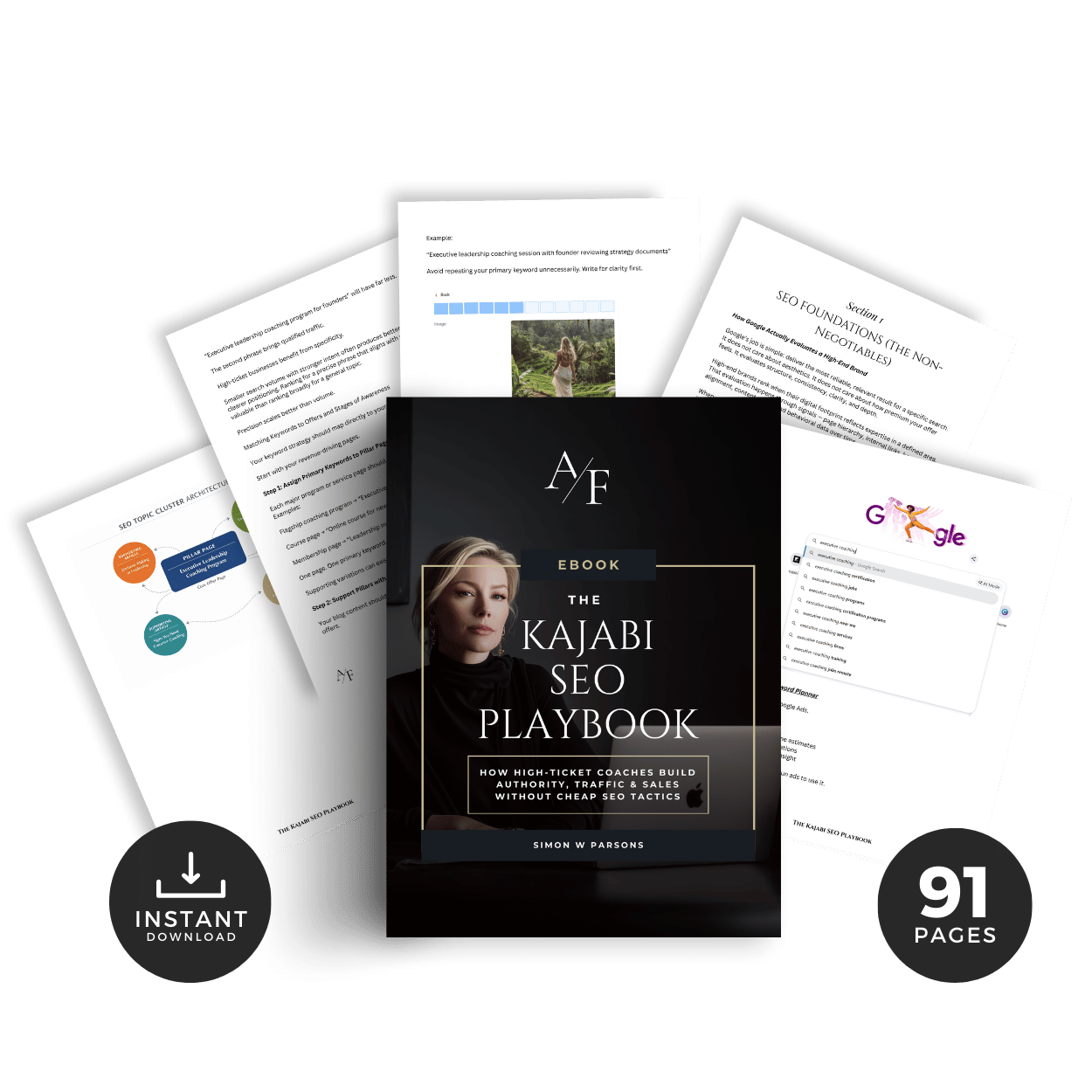
I put the entire system, the hierarchy framework, the keyword mapping process, the internal linking strategy, the blog cluster model, and the 30 day roadmap I used on my own site, into the Kajabi SEO Playbook. It's the same process outlined in this post, just with every step laid out so you can implement it without piecing it together yourself.
Get the Kajabi SEO Playbook → https://www.simonwparsons.com/kajabi-seo-guide
Articles in this series:
Article 1: Why Your Kajabi Site Isn't Ranking (Even Though It Looks Beautiful)
Article 2: How To Structure Your Kajabi Website for SEO
Article 3: Kajabi Blog Cluster Strategy
Article 4: Kajabi SEO Settings - What you actually need to use
In the meantime, start to think about the importance of optimizing your Kajabi website to take advantage of SEO.
Simon
Grab my free High Ticket Coach Branding Guide
A free guide for coaches, consultants, and creators who are ready to ditch the DIY look and step into a cohesive, premium brand presence that sells.
We hate SPAM. We will never sell your information, for any reason.