
How to Structure Your Kajabi Website for SEO
Jun 28, 2026
Most coaches think about their Kajabi site structure as a design decision. Which pages go in the navigation. How the menu looks. What order things appear in.
SEO sees your site structure completely differently. To Google, structure is a signal. It tells the algorithm which pages matter most, how topics relate to each other, and whether your site deserves to rank as an authority on anything in particular.
Getting this right doesn't require rebuilding your site from scratch. But it does require understanding what Google is actually looking for when it crawls your pages.
This is what is called your 'hierarchy'.
Why Site Structure Is an SEO Decision, Not a Design One
When Google crawls your Kajabi site, it's trying to answer a few basic questions. What is this site about? Which pages are the most important? How do the topics connect to each other?
Your site structure answers all three of those questions, whether you've thought about it deliberately or not.
A site with a clear hierarchy, where core pages sit at the top and supporting content sits underneath and points back up, is easy for Google to read. It signals authority, relevance, and organization.
A site where pages have been added over time without any deliberate logic is much harder to read. Google has to guess at what's important, and it usually guesses wrong.
The good news is that Kajabi gives you full control over your URL structure, your navigation, and your internal links. You have everything you need to build a well-structured site. You just need a clear framework for how to do it.
Make sure to also check out this post: Kajabi SEO - The Complete Guide For Coaches
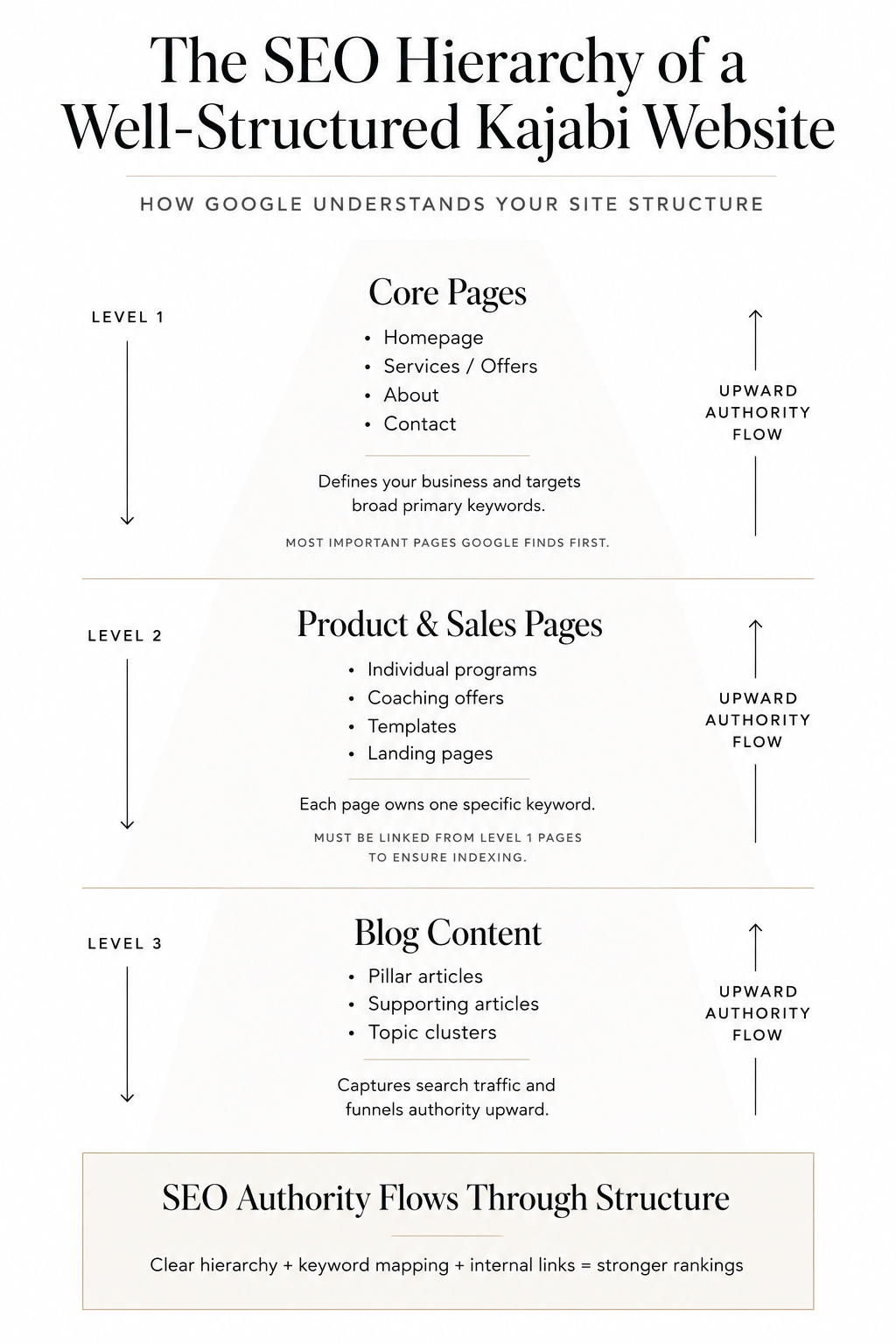
The Three Levels of a Well-Structured Kajabi Site
Think of your site as three distinct layers, each with a specific job.
Metadata. Level 1: Core pages
These are your most important pages. Homepage, main offer or services page, about page, contact page. These pages define what your business is and who it's for. They should be easy to find, clearly named, and built around the keywords that matter most to your business at the broadest level.
In Kajabi terms, these are your website pages that live in your main navigation. They're the pages most likely to appear in your auto-generated sitemap, which means Google finds them first.
Level 2: Product and sales pages
These pages sit one level below your core pages. They're specific to individual offers, programs, or services. Each one should target a more specific keyword than your core pages, and each one should be reachable from at least one Level 1 page.
One important note here: standalone Kajabi sales pages and landing pages built outside your main website navigation don't always get picked up by Kajabi's auto-generated sitemap. If your sales page lives at a custom URL that nothing on your site links to, there's a real chance Google hasn't found it. Internal links from your core pages down to these pages are how you make sure they get indexed.
Check out some of our Kajabi Sales Page Templates for inspiration.
Level 3: Blog content
Blog posts sit at the bottom of the hierarchy and do a specific job: they attract search traffic on specific topics and funnel it up toward your core and sales pages. A blog post on "how to structure a Kajabi website" should link to your main Kajabi services or templates page. A post on "how to price a coaching program" should link to your coaching offer page.
Blog posts that don't link upward are doing half a job. They might attract a reader, but they're not helping that reader move toward becoming a client.
How to Map Your Core Pages Before You Build (or Rebuild)
Before you touch a single URL or heading tag, map your pages on paper, or in a simple spreadsheet, and assign one primary keyword to each.
Start with your Level 1 pages. What is each one for? What would your ideal client type into Google to find that page? Your homepage is probably targeting something broad like "business coach for female entrepreneurs" or "life coach online." Your about page probably isn't targeting a keyword at all, and that's fine.
Then move to Level 2. Each sales or product page should own one specific keyword. "High ticket coaching program for women." "Online business coaching for coaches." "Kajabi website templates for coaches." One page, one keyword, no overlap.
The overlap problem is one of the most common structural mistakes I see. Two pages targeting the same keyword compete against each other in search results, which splits your authority and usually means neither page ranks as well as it should. If you have two pages going after the same term, consolidate them or differentiate the keyword targets.
Where Your Blog Fits Into the Structure
Your blog is not a separate part of your site. It's the engine that feeds authority into the rest of it.
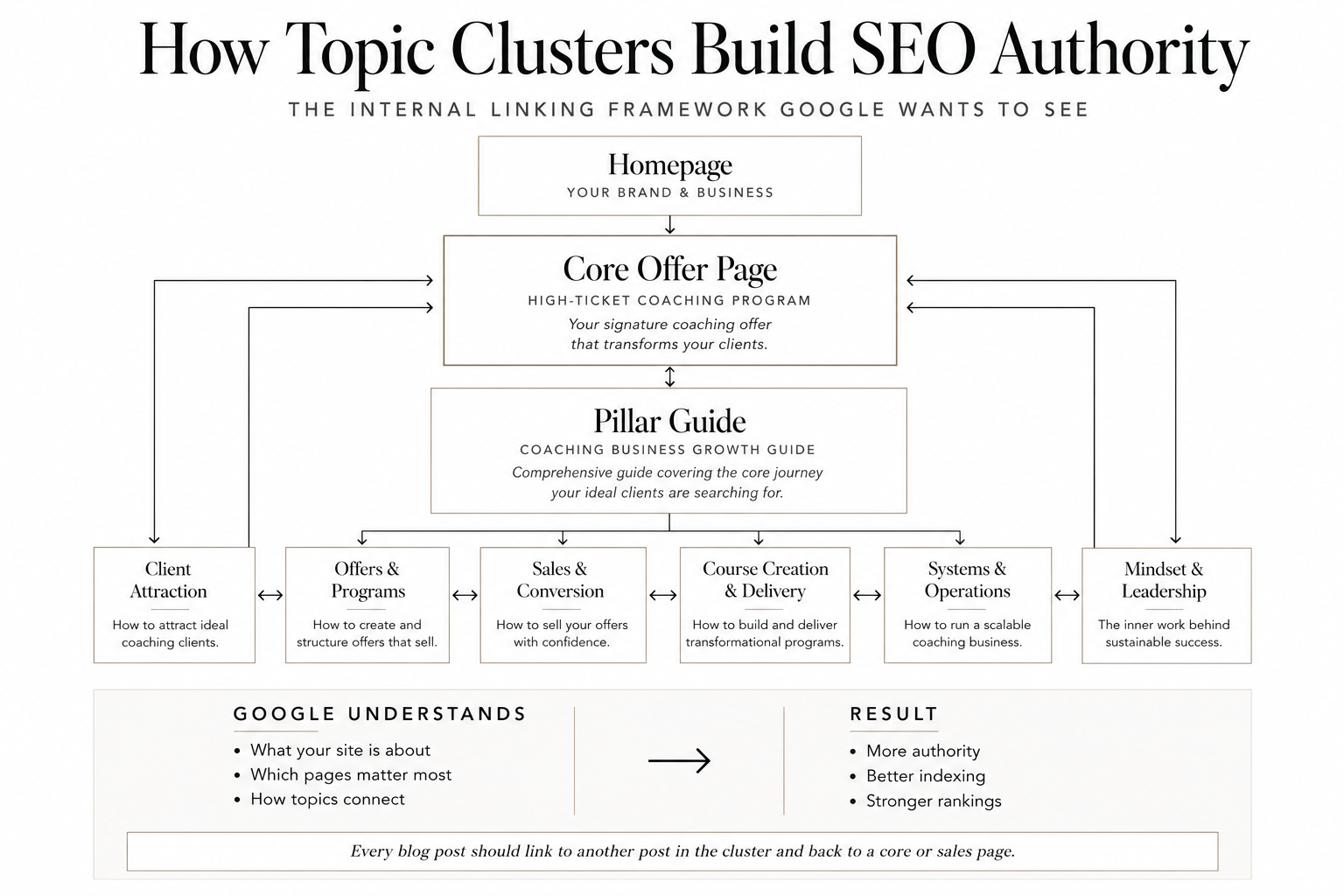
Every blog post should belong to a topic cluster: a group of posts built around a core subject, with one pillar post covering the topic broadly and supporting posts going deeper on specific subtopics. All of the supporting posts link back to the pillar. The pillar links back up to a relevant core or sales page.
That cluster structure is what tells Google you're an authority on a topic, not just someone who wrote about it once. A single post on Kajabi SEO is a signal. Five posts on Kajabi SEO, all connected to each other and pointing up toward a relevant page, is a pattern Google takes much more seriously.
If your blog currently looks like a collection of one-off posts with no connecting logic, that's fixable. Pick your two or three most important topics, identify which posts belong to each cluster, and start linking them together. You don't need to write new content to start building cluster structure. You just need to connect what you already have.
The Internal Linking Logic That Ties It All Together
Internal links are the connective tissue of your site structure. They're how Google understands the relationships between your pages, and they're how authority flows from one page to another.
The basic logic is this: links flow down from important pages to supporting pages, and back up from supporting pages to important ones.
Your homepage should link to your most important offer pages. Your offer pages should link to relevant blog posts. Your blog posts should link back to offer pages and to each other where it's genuinely relevant.
A few practical rules that make this easier to apply:
Every blog post should include at least two internal links. One should point to another blog post in the same cluster. One should point upward to a core or sales page.
Anchor text matters. The clickable text in your link should describe what the destination page is about, using natural language that includes the target keyword where it fits. "Read more here" tells Google nothing. "Kajabi website structure guide" tells Google exactly what it's linking to.
Don't link for the sake of linking. Every internal link should make sense to the reader. If you're forcing a link into a sentence where it doesn't belong, leave it out.
A Simple Audit You Can Do This Afternoon
If you're not sure whether your current Kajabi site has a clear structure, here's a quick way to find out.
Open a blank document and list every page on your site. For each one, write down: what keyword it's targeting (if any), which pages link to it, and which pages it links to.
If you find pages with no keyword target, no inbound links, and no outbound links, those are your problem pages. They're floating in isolation, invisible to Google, and doing nothing to support the rest of your site.
You don't need to fix everything at once. Start with your most important pages and work outward. Add a keyword target where there isn't one. Add one internal link pointing to each isolated page from somewhere relevant. Make sure each core page links down to at least one supporting page.
Small, deliberate changes to your site structure compound over time. A page that was invisible six months ago can start appearing in search results simply because you gave it a keyword target and connected it to the rest of your site.
Remember, it isn't just about SEO, your site must also look attractive. Learn more about Kajabi Design Mistakes that a lot of coaches make.
Final Thoughts
Site structure isn't the most exciting part of Kajabi SEO, but it's the foundation everything else sits on. Get the hierarchy right, map your keywords clearly, and build your blog around clusters rather than one-off posts, and the rest of your SEO work becomes significantly more effective.

If you want the full framework, including the exact hierarchy model I use, a keyword mapping template, and the internal linking system I apply to every Kajabi site I work on, it's all inside the Kajabi SEO Playbook. It's built specifically for coaches who want a clear, structured system rather than a list of generic SEO tips.
Simon
Keep learning:
- Previous Article: Why Your Site Isn't Ranking (Even Though It's Beautiful)
- Next Article: Kajabi Blog Cluster Strategy for SEO
Grab my free High Ticket Coach Branding Guide
A free guide for coaches, consultants, and creators who are ready to ditch the DIY look and step into a cohesive, premium brand presence that sells.
We hate SPAM. We will never sell your information, for any reason.