
The Kajabi Blog Strategy That Actually Builds SEO Authority
Jul 01, 2026
Most coaches who blog on Kajabi are doing more work than they need to and getting less from it than they should.
They publish consistently. They write about things their audience cares about. They share every post on Instagram. And then they look at their traffic numbers six months later and wonder why nothing has moved.
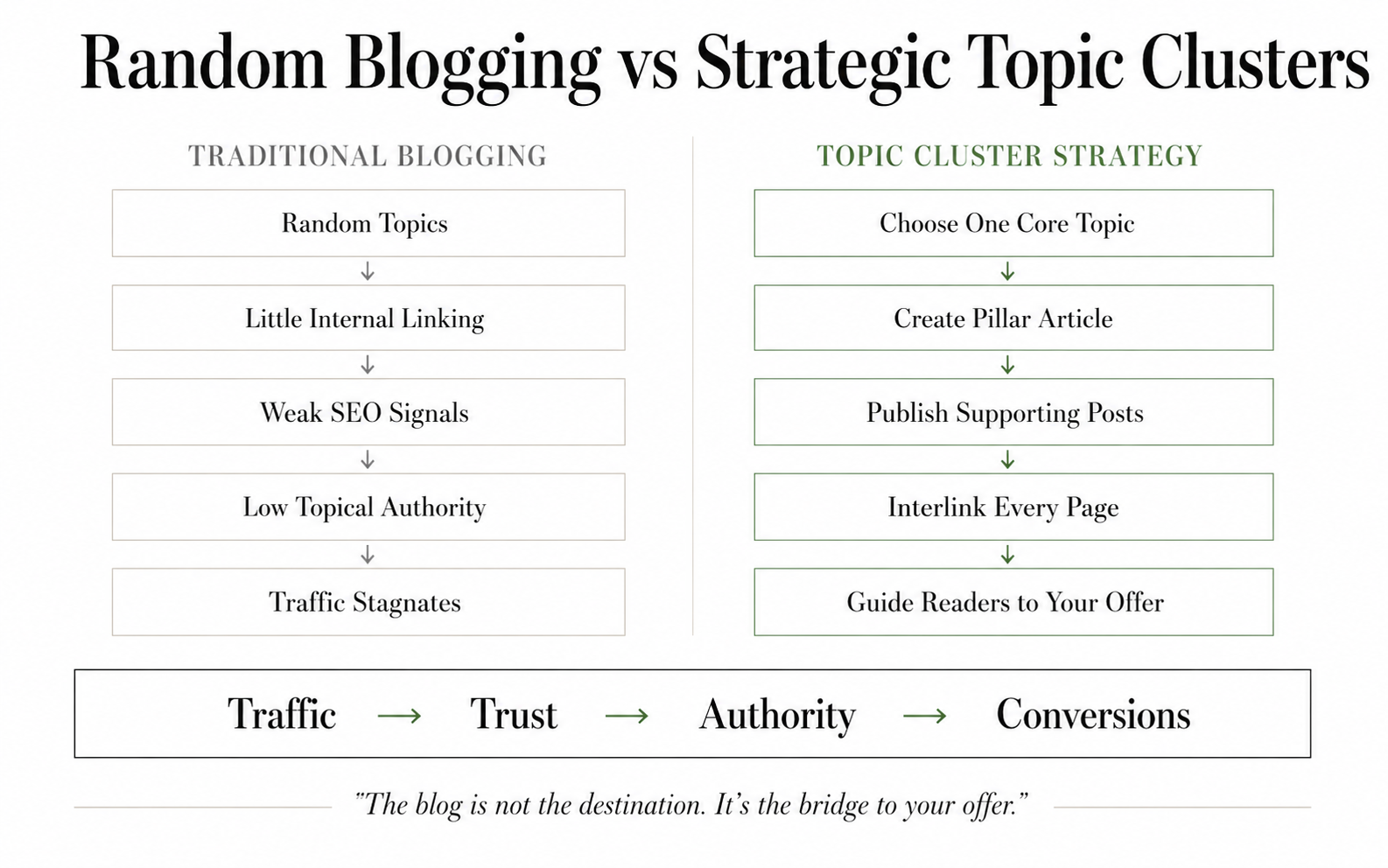
The problem isn't the effort. It's the structure. Random posts, no matter how good they are individually, don't build SEO authority. A deliberate content strategy does.
Here's what that looks like on Kajabi.
Why Most Kajabi Blogs Don't Get Any Traffic
A blog post is not a strategy. It's a piece of a strategy.
When you publish posts on unconnected topics, Google sees a site that knows a little about a lot of things. That's not how authority gets built. Authority comes from demonstrating deep, consistent expertise on a specific subject, and the way you do that through content is by publishing multiple connected pieces around the same topic over time.
A single post about Kajabi SEO tells Google you wrote about SEO once. Five connected posts about Kajabi SEO, all linking to each other and building on a common framework, tells Google your site is a genuine resource on that topic. The difference in how those two approaches perform in search results is significant.
The other issue is internal linking, or the lack of it. Most coaches publish a post and move on. There's no thought given to how that post connects to other posts, or how it points readers toward the next step. Posts that don't link to each other don't build cluster authority. They just sit there individually, each one starting from zero.
What a Topic Cluster Actually Is (And Why It Works)
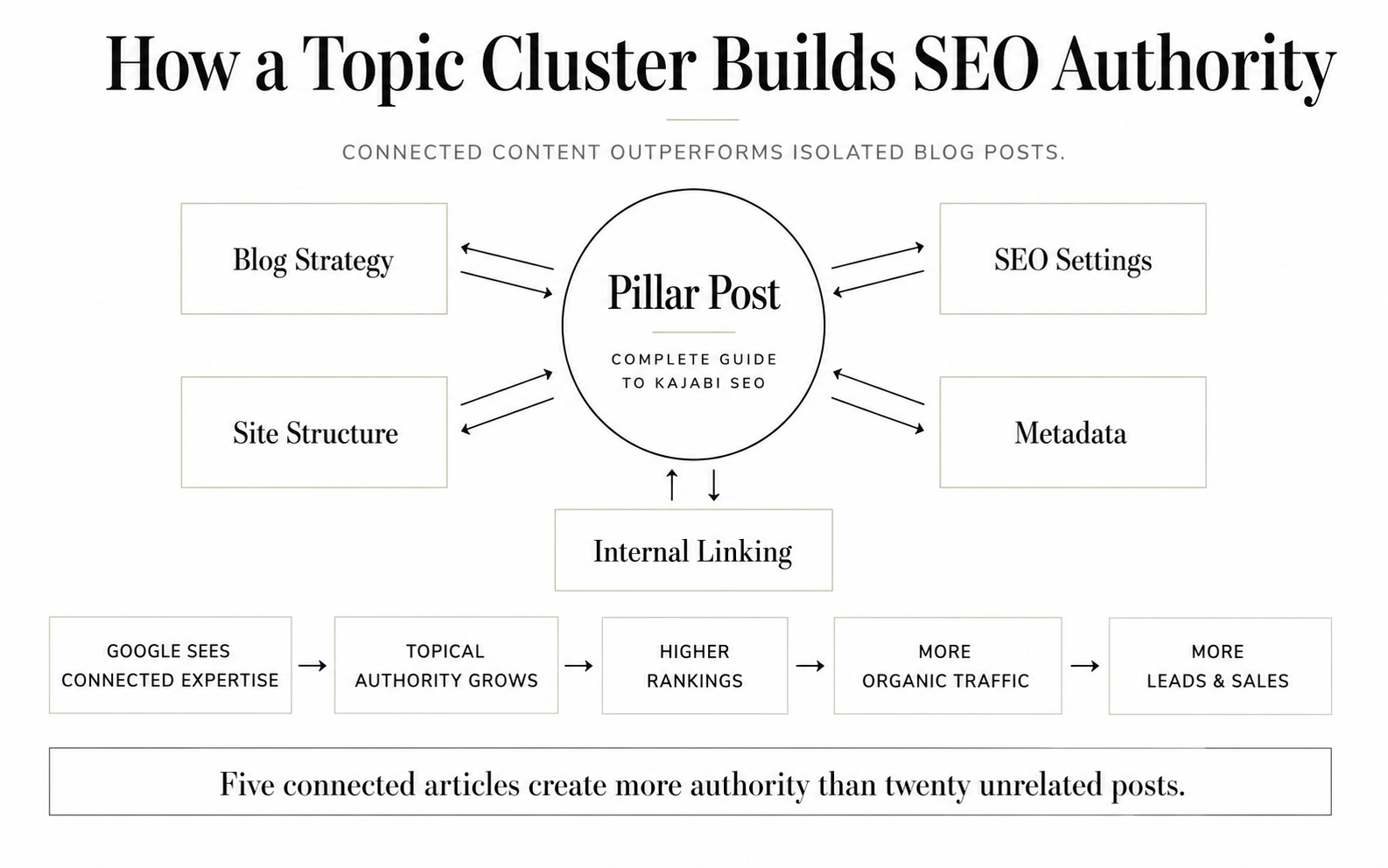
A topic cluster is a group of blog posts built around a single core subject. It has two components: a pillar post and a set of supporting posts.
The pillar post covers the topic broadly. It's the definitive resource on the subject, the post you'd send someone who asked you to explain everything about a topic in one place. It targets the broadest keyword in the cluster and links out to each of the supporting posts.
The supporting posts each go deeper on a specific subtopic within the broader subject. They target more specific, lower-competition keywords. And they all link back to the pillar.
The cluster you're reading right now is a good example. The pillar post covers Kajabi SEO broadly. This post goes deeper on blog strategy specifically. Two other posts in the cluster cover site structure and SEO settings. All of them link back to the pillar, and the pillar links out to all of them.
That interlinking structure is what tells Google the cluster belongs together. It sees a network of related content, all reinforcing the same topic, and it starts to treat your site as an authority on that subject.
How to Choose Your Cluster Topics
Your cluster topics should sit at the intersection of two things: what your ideal client is searching for, and what you can credibly write about with depth and specificity.
For most coaches, that means picking topics connected directly to your offer. A business coach might build clusters around topics like "how to sign high ticket clients," "online coaching business setup," or "Kajabi for business coaches." A life coach might build around "mindset coaching tools," "how to start a coaching business," or "life coaching program structure."
Each of those is a potential cluster topic. Each one could support a pillar post and four or five supporting posts before you've exhausted the subject.
A few questions to help you narrow it down:
What does your ideal client type into Google before they find you? What questions do you answer on discovery calls over and over again? What topics do you already have two or three posts about that could be connected into a cluster?
That last one is worth sitting with. A lot of coaches already have the raw material for a cluster sitting in their blog archive. The posts just aren't connected to each other yet.
How to Build a Topic Cluster on Kajabi Step by Step
Once you've chosen a cluster topic, here's the process.
Start with the pillar post. Write the broad, comprehensive resource first. This is usually your longest post, somewhere around 1,500 words, and it should give a genuine overview of the topic without going so deep on any one subtopic that there's nothing left to say in the supporting posts.
Map your supporting posts. Look at the pillar and identify the sections that could be expanded into their own standalone post. Each H2 in the pillar is a potential supporting post topic. In a pillar about Kajabi SEO, the sections on site structure, blog strategy, metadata, and SEO settings each have enough depth to carry their own post.
Write and publish the supporting posts. Each one should link back to the pillar in a natural, contextually relevant way. Not a forced "read my pillar post here" at the end, but a genuine reference mid-article where the link adds something for the reader.
Go back and update the pillar. Once your supporting posts are live, add links from the pillar out to each of them. This completes the cluster structure and makes the interlinking work in both directions.
In Kajabi specifically: keep your blog post URLs clean and keyword-focused. Kajabi uses flat URL structures, so your post will live at yoursite.com/blog/your-post-slug rather than in a subfolder. Make sure the slug includes your primary keyword and skip the filler words. "/blog/kajabi-blog-seo-strategy" is better than "/blog/the-kajabi-blog-strategy-that-actually-builds-seo-authority."
How Often You Actually Need to Publish
Less often than you think, if what you're publishing is part of a deliberate cluster.
One well-structured cluster of five connected posts will do more for your SEO than twenty scattered posts on unrelated topics. Consistency matters, but consistency of structure matters more than consistency of volume.
A realistic publishing cadence for most coaches building clusters is one post per week while you're building a cluster, then one or two posts per month to maintain momentum once the cluster is complete. That's sustainable, and it's enough to show Google that your site is active and being updated.
What you're trying to avoid is the pattern most coaches fall into: publishing in bursts when motivation is high, then going quiet for weeks, with no strategic thread connecting any of it. That pattern produces traffic spikes that go nowhere and an archive that Google doesn't know what to do with.
The One Thing That Makes a Blog Cluster Work
You can do everything else right and still have a cluster that underperforms if you skip this: every post in the cluster needs to link upward toward something that converts.
A cluster is not just a way to attract traffic. It's a funnel. Readers land on a supporting post, follow a link to the pillar, and from the pillar they should have a clear path to whatever you're selling.
That path is usually a link to a product page, a sales page, or a lead magnet. In this cluster, every post links to the Kajabi SEO Playbook. The blog post you're reading right now is not the destination. It's the bridge.
If your cluster attracts readers but doesn't point them anywhere, you've built an audience with no offer in front of it. Add a clear, specific CTA to every post, and make sure the pillar in particular gives readers an obvious next step once they've finished reading.
Now It's Your Turn - Make It Happen

Blogging on Kajabi works when it's built around a deliberate structure. Pick a topic your ideal client is searching for, build a pillar post that covers it broadly, support it with posts that go deeper on specific subtopics, connect them all with internal links, and point the whole cluster toward your offer.
That's the system. It's not complicated, but it does require planning before you publish, not after.
The Kajabi SEO Playbook walks through the full cluster-building process in detail, including the keyword research method I use to choose cluster topics, the internal linking framework that ties everything together, and the 30-day roadmap for getting your first cluster live without it taking over your entire content calendar.
Keep Learning:
- Previous Article: How to structure your Kajabi website for SEO
- Next Article: coming soon
Grab my free High Ticket Coach Branding Guide
A free guide for coaches, consultants, and creators who are ready to ditch the DIY look and step into a cohesive, premium brand presence that sells.
We hate SPAM. We will never sell your information, for any reason.