Common Mistakes Coaches Make When Choosing Kajabi Templates
Feb 16, 2026
I want to talk about mistakes in a practical way, not in a dramatic way.
Most coaches don’t choose the wrong Kajabi template because they lack taste. They choose the wrong one because they’re solving the wrong problem.
Templates get blamed for issues that usually have more to do with timing, expectations, or clarity.
Once you understand that, most of the common mistakes become easier to avoid.
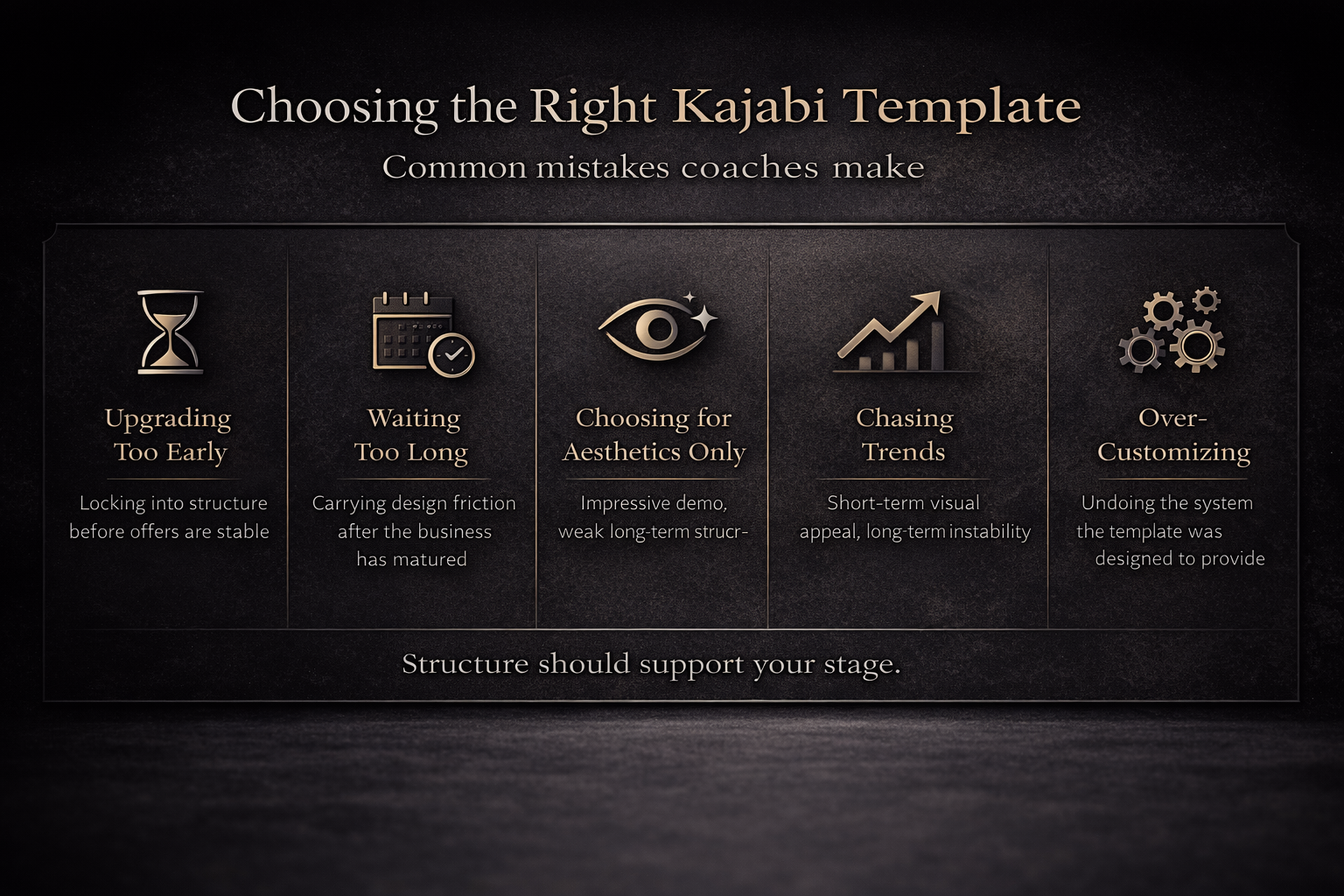
The first mistake is upgrading too early.
It’s tempting to look for a polished template when your business still feels unsettled. A cleaner layout feels like progress. But if your offer is still shifting or your messaging is still evolving, locking into a structured template can feel restrictive instead of helpful.
Structure works best when the business underneath it is stable.
The second mistake is waiting too long.
On the other side, some coaches hold onto a DIY setup long after it’s stopped serving them. Pages drift. Sections get duplicated. Design decisions pile up. Nothing is broken, but nothing feels cohesive either.
That’s usually a sign that it’s time for more structure, not more customization.
Another common mistake is choosing based on aesthetics alone.
It’s easy to gravitate toward a template that looks impressive in a demo. But demos don’t show what happens six months later when you’ve added pages, updated offers, and rewritten sections.
The real test is whether the structure still feels clear once the novelty wears off.
A strong template handles hierarchy well. It makes it obvious what matters on the page and what doesn’t. If the layout competes with your content, that friction will show up over time.
There’s also the mistake of chasing trends.
Design trends move quickly. Heavy visual effects, complex layouts, and overly stylized sections may look current today but can age quickly. For coaches building long-term businesses, stability usually matters more than novelty.
Restraint tends to last longer than cleverness.
Another pattern I’ve noticed is over-customizing.
Templates are meant to reduce decisions. When every section is modified beyond recognition, the original structure often disappears. At that point, you’re essentially designing from scratch again, just inside a template shell.
If a template requires constant reworking to feel aligned, it may not be the right one.
Finally, many coaches underestimate how much consistency matters.
A template shapes more than the homepage. It sets the tone for how every page on your site functions.
Headings follow a pattern. Buttons appear in predictable places. Spacing creates a rhythm people grow familiar with as they move through your content. Over time, that consistency builds trust quietly.
When those elements shift from page to page, the site can feel unsettled, even if the work itself is strong. Most visitors won’t be able to explain what feels off. They’ll just feel it.
That’s why structure matters beyond the first impression.
Most of these mistakes aren’t dramatic. They’re gradual.
They show up as friction. As hesitation before sharing your link. As a quiet sense that the site doesn’t quite reflect the level you’re operating at.
Choosing the right Kajabi template isn’t about finding the most impressive design. It’s about matching structure to your stage and committing to clarity over novelty.
When that alignment is there, the website stops feeling like a project and starts functioning as infrastructure.
If you want to explore templates built around clarity and long-term consistency, you can browse my Kajabi templates here. They’re designed to support stable businesses without relying on trends or unnecessary complexity.
Next, I’ll break down how Kajabi website templates differ from sales page templates, and why using the wrong one in the wrong place creates unnecessary friction.
Grab my free High Ticket Coach Branding Guide
A free guide for coaches, consultants, and creators who are ready to ditch the DIY look and step into a cohesive, premium brand presence that sells.
We hate SPAM. We will never sell your information, for any reason.