Are Kajabi Templates Worth It? Pros, Cons, and When to Use Them
Jan 08, 2026
I want to answer this question honestly, because it comes up a lot and the advice around it is usually unhelpful.
Most people frame Kajabi templates as either a shortcut you should always use or something you only need if you don’t know what you’re doing. Neither of those is true, and both miss the real point.
Kajabi templates are useful at a very specific stage, for a very specific reason.
If you understand that, the decision gets a lot easier.
Most coaches who ask this question aren’t new to Kajabi. They’ve already built pages. They know how the editor works. They’ve launched something that functions. What they’re reacting to isn’t confusion — it’s friction.
They’re tired of reopening pages and feeling like nothing is quite settled. Layouts keep drifting. Sections feel slightly off. Every update turns into a design decision they didn’t plan to make.
That’s the context where templates start to matter.
Kajabi templates don’t fix unclear offers or weak messaging. They don’t replace thinking. What they do is remove repeated structural decisions so you’re not re-solving the same problems every time you touch your site.
That distinction is important.
If you’re still figuring out what you sell, templates can feel premature. In that phase, building manually can actually be useful because it forces you to learn the platform and clarify your direction. You’re experimenting, and flexibility matters more than polish.
Templates start to earn their keep once experimentation slows down and refinement begins.
That’s usually when coaches realize their site technically works, but feels heavier than it should. Not broken. Just unresolved.
In those situations, templates help because they create consistency. When layout, spacing, and hierarchy are already handled, the site stops drifting every time you add something new. Updates become simpler. Maintenance takes less mental energy. You stop questioning the structure and focus on the content.
That’s been my own experience as well.
I didn’t start using templates because I wanted things faster. I started because I didn’t want to keep revisiting design decisions that had already been made. Once the structure was stable, everything else moved more smoothly. Writing, publishing, and updating stopped feeling like friction points.
That’s when templates made sense.
There are downsides, though, and they’re worth acknowledging.
Templates impose a point of view. If the structure doesn’t match how you think or work, you’ll feel boxed in quickly. Some templates look good in demos but require constant adjustment in real use. Others assume a funnel-heavy business model that doesn’t fit coaches who rely on trust, referrals, or longer decision cycles.
The wrong template creates more work than it saves.
That’s why choosing which template you use matters more than deciding whether to use one at all.
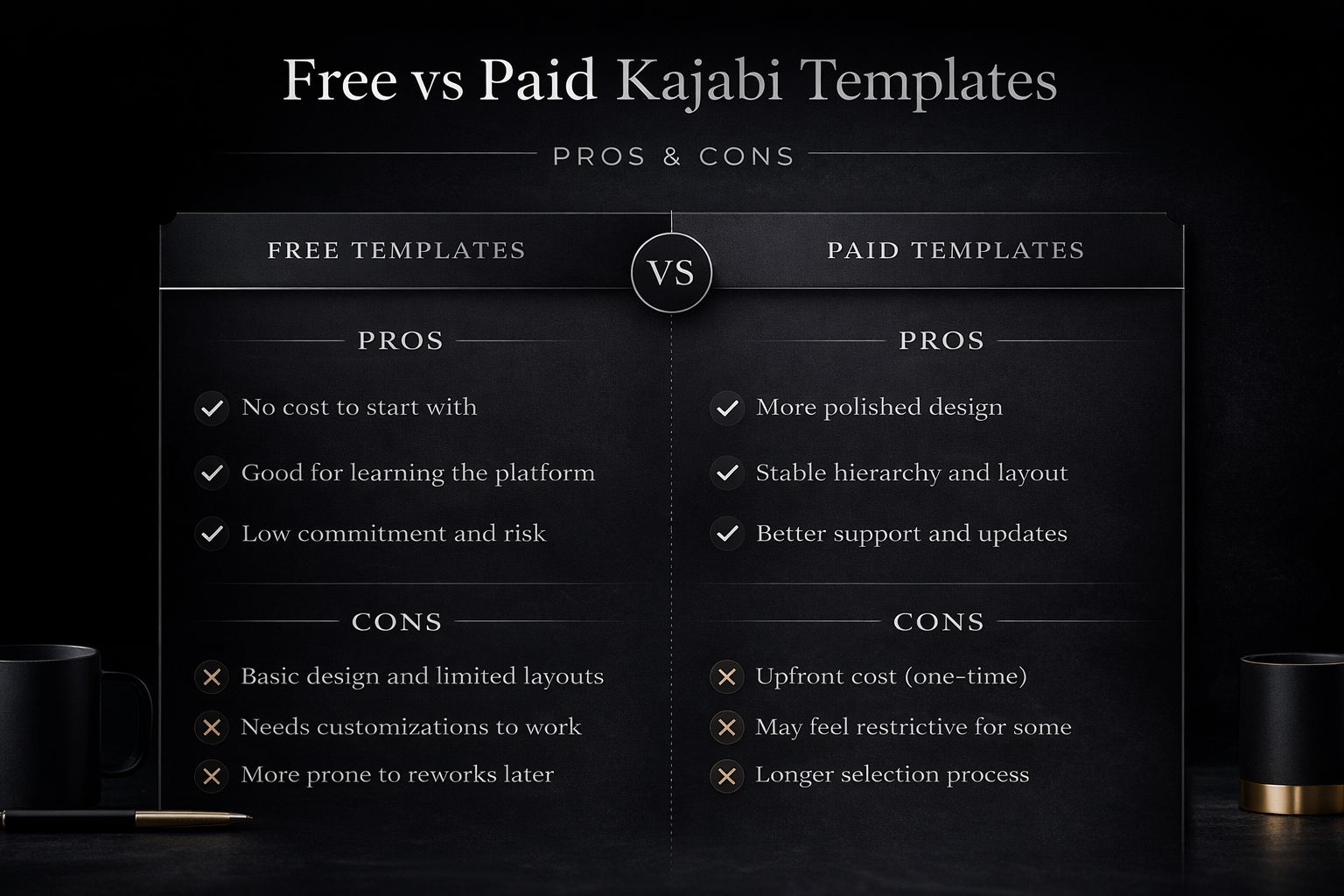
Free templates can be helpful early on. They’re a low-commitment way to learn Kajabi and understand how pages are structured. Paid templates tend to make more sense later, when you care less about experimentation and more about longevity.
The difference usually isn’t features. It’s restraint. Better templates tend to make fewer assumptions, use cleaner hierarchy, and hold up longer without needing redesigns.
So are Kajabi templates worth it?
They are when you know what you’re building and want your site to stop feeling provisional. They’re helpful when consistency matters more than total control, and when you plan to maintain your site instead of rebuilding it every few months.
They’re not necessary when you’re still discovering your direction, or when you genuinely enjoy designing every detail yourself.
Neither approach is wrong. The mistake is using templates too early, or choosing ones that don’t fit how you actually work.
That’s really what this comes down to.
Templates aren’t shortcuts. They’re systems. When the structure is handled well, you’re free to put your attention where it belongs — on your work, your clients, and the ideas you’re trying to communicate.
If you want to see how I approach this in practice, you can explore my Kajabi templates here. They’re built to be flexible, stable, and easy to live with over time.
Next, I’ll walk through what actually makes a Kajabi template convert, and why hierarchy and layout matter more than most people think.
Grab my free High Ticket Coach Branding Guide
A free guide for coaches, consultants, and creators who are ready to ditch the DIY look and step into a cohesive, premium brand presence that sells.
We hate SPAM. We will never sell your information, for any reason.