
Kajabi vs WordPress for Coaches: Which Platform Makes More Sense?
Apr 16, 2026
If you've spent any time researching where to build your coaching website, you've almost certainly landed in the middle of this debate. Kajabi on one side, WordPress on the other. Both have passionate advocates. Both can technically do the job. But "technically possible" and "right for your business" are two very different things.
This is the honest breakdown — no affiliate bias, no platform cheerleading. Just what each one actually does well, where each one falls short, and which type of coach is likely to thrive on each.
Two platforms, very different jobs
Kajabi and WordPress are not really competing for the same thing, even though they often get compared as if they are.
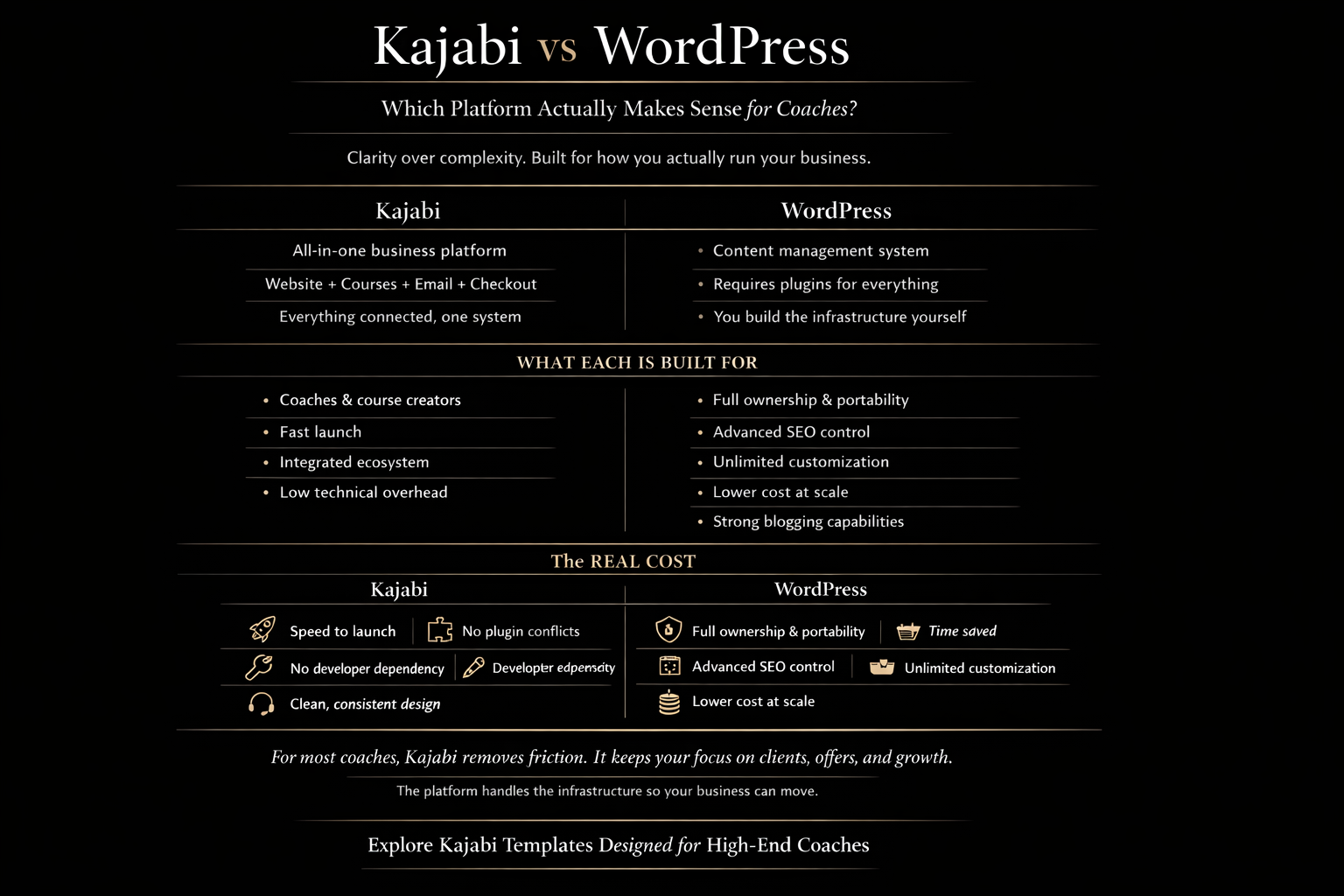
Kajabi is an all-in-one business platform. Your website, your courses, your memberships, your email marketing, your checkout pages, your pipelines — all of it lives in one system, under one login, billed as one subscription.
WordPress is a content management system. It's the foundation that millions of websites are built on, but it doesn't come with any of the business infrastructure a coach needs. You build that by layering in plugins, third-party integrations, and in most cases, a developer.
That distinction matters more than almost anything else in this comparison.
What Kajabi is built to do
Kajabi was designed specifically for people who create and sell knowledge online. Coaches, course creators, membership site owners, consultants. The entire platform assumes that's what you're doing.
That means out of the box, you get a website builder, a course hosting system, email marketing, sales pages, checkout pages, automations, a mobile app for your clients, and basic analytics. You don't need to figure out how all the pieces connect — they're already connected.
For a coach who wants to spend her time coaching rather than managing tech, that integration is the core value proposition.
Starting with a Kajabi Website template and branching out into sales pages, lead magnets and booking pages is a great flow
What WordPress is built to do
WordPress powers around 40% of the internet, which tells you something about its flexibility. It can be anything. A blog, an e-commerce store, a membership site, a coaching platform, a portfolio. That flexibility is genuinely powerful.
But it comes with a tradeoff. WordPress out of the box is just a website. To sell a course, you need a plugin like LearnDash or LifterLMS. To take payments, you need WooCommerce or another gateway. To run email marketing, you need a separate tool. To protect member content, another plugin. Each one adds cost, complexity, and another potential point of failure.
WordPress rewards people who enjoy building systems. It can frustrate people who just want to run a business.
Where Kajabi wins for coaches
Speed to launch. A coach using Kajabi with a quality template can have a fully functional website, sales page, checkout, and course delivery set up in a weekend. That's not an exaggeration. The infrastructure is already there.
Everything in one place. No plugin conflicts. No integration headaches. No wondering why your checkout stopped talking to your email list. Kajabi handles the conversation between all its parts internally.
No developer dependency. Most coaches using WordPress eventually hit a wall that requires either learning to code or hiring someone who can. Kajabi is designed to be self-managed by non-technical users.
Consistent design. Kajabi's template system means you can have a professional, cohesive website without a design background. A well-chosen Kajabi template handles the visual consistency for you.
Support. Kajabi has a dedicated support team and an active community. When something breaks or you're stuck, help is accessible. WordPress support is fragmented across your hosting provider, your theme developer, and every plugin you're using.
Where WordPress has the edge
Ownership and portability. With WordPress, you own your site outright. You can move hosts, change everything, export your data freely. With Kajabi, you're on their platform — if they change pricing or go under, your business infrastructure is affected.
SEO flexibility. WordPress, especially with a plugin like Yoast or RankMath, gives you granular control over your SEO. Schema markup, redirect management, advanced sitemaps. Kajabi's SEO tools are solid for most coaches, but they're not as deep.
Design customization. If you have a very specific visual vision and the technical ability to execute it, WordPress with a custom theme or page builder can go further than Kajabi's template system. The ceiling is higher.
Cost at scale. Kajabi's subscription increases as your business grows. A high-volume operation might eventually find WordPress more cost-effective once you factor in all the pieces.
Blogging and content. WordPress was built as a blogging platform and it still leads there. If long-form content and a sophisticated editorial workflow are central to your strategy, WordPress handles it more naturally.
The real cost of each platform
This is where a lot of comparisons get misleading.
People see Kajabi's monthly fee and think WordPress is cheaper because it's free. But WordPress hosting costs money. Premium themes cost money. The plugins you need to run a coaching business cost money. And if you're not technical, a developer costs a lot of money.
A realistic WordPress setup for a coach — decent hosting, a quality theme, the core plugins for courses, payments, email, and membership protection — can easily run $100 to $200 per month before you've accounted for a developer's hourly rate.
Kajabi's entry plan is more expensive month-to-month, but it includes everything. For most coaches, the actual cost difference is smaller than it looks on paper, and the time savings tip it firmly in Kajabi's favor.
Which type of coach should use Kajabi
Kajabi is the stronger choice if you:
- Want to get launched quickly without building a technical stack
- Run courses, memberships, or group programs alongside your coaching
- Want your website, email, and course delivery talking to each other automatically
- Have no interest in managing plugins, updates, or site maintenance
- Are building a high-ticket, brand-focused coaching business where design consistency matters
- Value your time above all else
Most coaches reading this fall into this category.
Which type of coach might prefer WordPress
WordPress makes more sense if you:
- Have existing technical skills or a trusted developer on retainer
- Need very specific custom functionality that Kajabi can't provide
- Are running a large content operation where advanced SEO control is critical
- Want full data ownership and maximum portability from day one
- Are comfortable managing hosting, updates, and plugin ecosystems
This is a real use case — but it's less common among coaches who are primarily focused on delivering transformational work rather than building web infrastructure.
The bottom line
For most coaches, Kajabi wins. Not because WordPress isn't capable, but because the friction that comes with building and maintaining a WordPress site takes time and energy away from the work that actually grows a coaching business.
Kajabi lets you focus on your clients, your offers, and your brand. The platform handles the infrastructure.
If you're on Kajabi and want a website that actually looks like the premium brand you're building, the starting point is a quality template. The Brooklyn Collection was designed for high-ticket coaches who want a site that feels elevated, not assembled.
Browse the full Kajabi template collection and find the design that matches where your brand is headed.
In my next article, I'll share with you what coaches should first build when using Kajabi.
Simon
Grab my free High Ticket Coach Branding Guide
A free guide for coaches, consultants, and creators who are ready to ditch the DIY look and step into a cohesive, premium brand presence that sells.
We hate SPAM. We will never sell your information, for any reason.