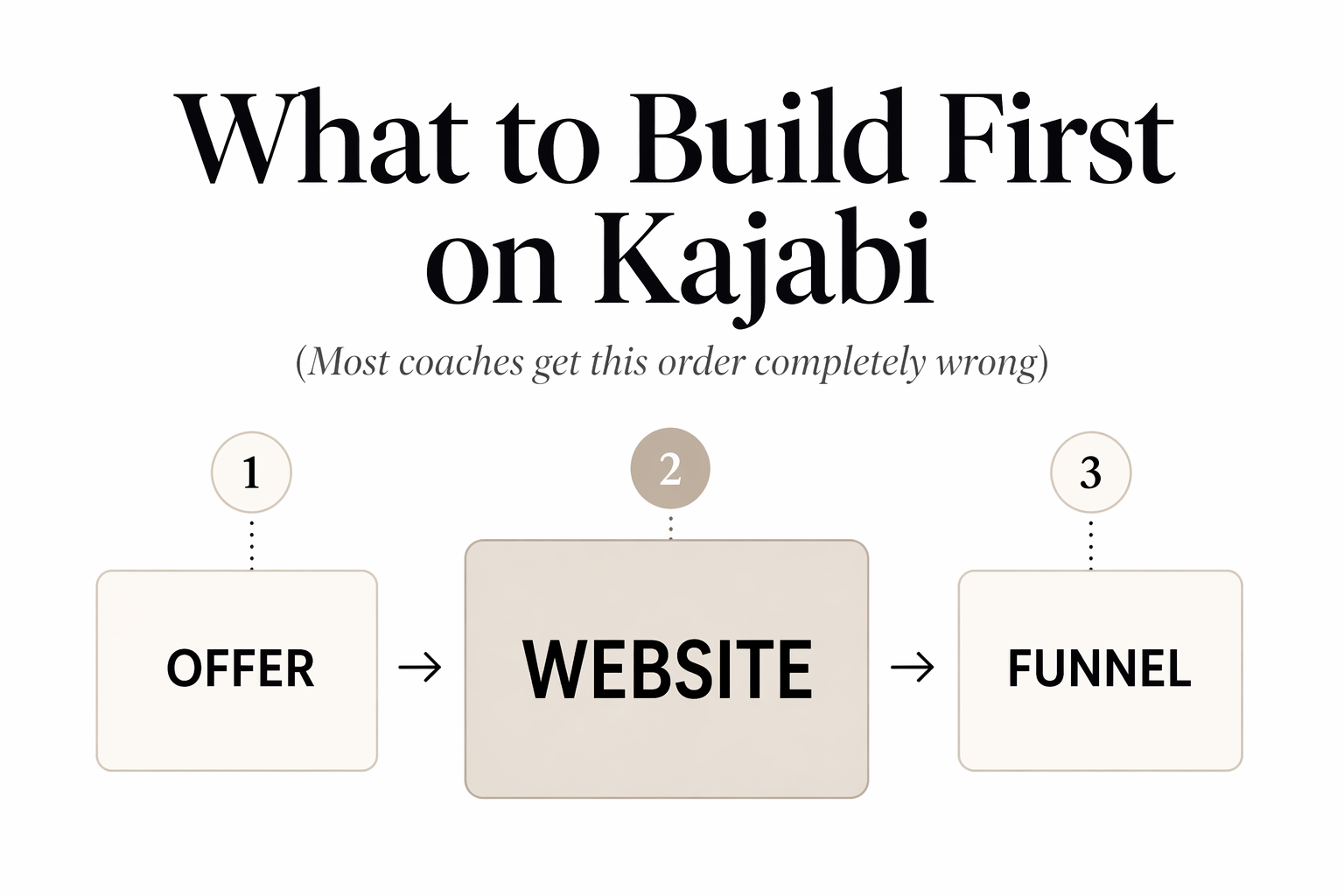
What to Build First on Kajabi: Website, Offer, or Funnel?
Apr 24, 2026
Most coaches open Kajabi for the first time and immediately start clicking around — building pages, tweaking colors, watching tutorials about funnels. Three hours later, they have half a website and no clear path to making a sale.
It's a completely understandable way to get stuck. Kajabi is a powerful platform, and it can do a lot. But "can do a lot" is exactly why coaches need a clear build order before they start.
This is that build order.
The Mistake Most Coaches Make When They First Log Into Kajabi
The most common mistake is treating Kajabi like a design project instead of a business infrastructure project.
Coaches spend their first weeks obsessing over fonts, hero images, and whether their brand palette looks right on the home page. The website looks beautiful. There's just nothing to actually buy yet.
On the other end of the spectrum, some coaches skip the website entirely and try to build a funnel first. They've heard that funnels convert better than websites, which is true — but a funnel without a clear offer behind it is just a sequence of empty pages.
Both approaches skip the only thing that actually matters first: your offer.
Start Here: Your Core Offer
Before you build a single page, you need to know exactly what you're selling, at what price, and to whom.
That sounds obvious. It usually isn't. Many coaches set up Kajabi with a vague sense of "coaching packages" in mind, but haven't nailed down what the package actually includes, what outcome it promises, or why someone would buy it at that price over anything else.
Kajabi calls these Products. In the platform, your offer lives inside a Product — whether that's a 1:1 coaching program, a group course, a membership, or a digital download.
Your first task inside Kajabi isn't building a website. It's creating your Product, writing the description, setting the price, and making sure the checkout experience is clean and functional.
Only once you know what you're selling can you build pages that actually sell it.
Then Build This: Your Website (And What It Actually Needs)
Once your offer exists, your website has a job to do: introduce you, establish trust, and direct visitors toward that offer.
A launch-ready Kajabi website doesn't need to be elaborate. At minimum, it needs:
A home page that communicates what you do, who you help, and what the next step is. Your headline does the heavy lifting here. If someone can't tell within ten seconds whether you're the right fit for them, they'll leave.
An about page that builds credibility without reading like a CV. Coaches often overcomplicate this. The goal isn't to list every qualification — it's to make the right person feel like they've found their person.
A work with me or services page that presents your offer clearly. This is where the Product you set up earlier gets introduced properly, with context, pricing, and a clear call to action.
A contact or application page if your offer involves a discovery call or application process. High-ticket coaching almost always does.
That's it for launch. No blog required. No resource library. No podcast page. Those come later, once the core business is working.
The website's job at this stage is simple: convert the right people, repel the wrong ones, and make you look like the premium option you are.
What About a Funnel? Here's When It Matters
A funnel — typically a landing page, an opt-in form, and a follow-up email sequence — becomes relevant once you have traffic to send somewhere.
Coaches sometimes build funnels before they have an audience, which means building an elaborate system to capture leads they don't have yet. That's not a bad thing to have eventually, but it's not where your energy should go first.
The right time to build a funnel is when you're actively driving traffic to a specific offer. That might look like a free guide, a webinar registration, or a challenge opt-in that leads into a paid program.
Inside Kajabi, funnels are built using the Pipelines feature (now called Funnels in newer versions). It's one of the platform's most powerful tools, and also one of the most time-consuming to set up correctly.
Build your funnel when you have something to funnel people toward. Not before.
For lower ticket offers that are under $297, I'd consider skipping a sales page and using an upgraded Kajabi Checkout Page. Think of this as longer than a standard (and boring) checkout page but shorter than a traditional sales page.
The Right Order Changes Depending on Where You Are
The build order above assumes you're starting from scratch. But not everyone is.
If you already have an audience — even a small email list — your priority shifts slightly. You can move faster on the funnel piece because you have people to send through it. In that case, a simple landing page connected to your email list and a clear offer can generate revenue before your full website is even finished.
If you're migrating from another platform, your offer likely already exists. Focus on rebuilding your website first, making sure the design and copy reflect where your brand is now, not where it was two years ago. Then reconnect your checkout and delivery systems inside Kajabi.
If you're brand new to both Kajabi and online coaching, give yourself permission to start small. One offer, one simple website, one way to get paid. The rest gets built as the business grows.
What a Professional Kajabi Website Should Look Like at Launch
The biggest thing coaches underestimate is how much first impressions drive buying decisions.
A generic Kajabi website — the kind that uses default templates without customization, or mixes fonts and colors without a clear design direction — signals that the business isn't quite ready yet. Potential clients pick up on that, even if they can't articulate why.
A premium Kajabi template gives you the structure, the visual hierarchy, and the design foundation to look like an established brand from day one. Not because aesthetics are more important than substance, but because your website is often the first interaction a potential client has with you. It should feel like the experience of working with you.
I designed the Brooklyn Collection specifically for coaches who are building something premium and want their digital presence to reflect that. It includes website templates, sales page templates, and everything you need to launch without spending months on design.
If you're at the stage of setting up Kajabi for the first time, explore the Brooklyn Collection here and see whether it's the right fit for your launch.
Simon
Grab my free High Ticket Coach Branding Guide
A free guide for coaches, consultants, and creators who are ready to ditch the DIY look and step into a cohesive, premium brand presence that sells.
We hate SPAM. We will never sell your information, for any reason.