Kajabi vs. Etsy vs. Gumroad: Where Should You Actually Sell Your Digital Products?
May 31, 2026
Most creators spend hours debating Etsy versus Gumroad, comparing transaction fees down to the decimal point and asking which one is easier to set up. That's not a bad question. But it's the wrong question if you're building something that's supposed to last.
If you're already on Kajabi, or seriously considering it, the real comparison is different. This article is the one I wish existed when I was figuring this out.
The Comparison Nobody Is Having
The Etsy versus Gumroad debate assumes you're optimizing for simplicity or discoverability. Both are legitimate goals. But neither platform was built for the kind of business most coaches and course creators are actually trying to build.
Kajabi sits in a completely different category. It's not really competing with Etsy or Gumroad at the listing level. It's competing with your entire stack: your email marketing platform, your course hosting, your website builder, your checkout system, and your community tool, all at once.
So yes, let's compare the three. But let's be clear about what we're actually comparing.
Where Does Your Traffic Come From?
This is the question that matters more than any fee comparison, and almost nobody leads with it.
Etsy has over 90 million active buyers. You list a product, optimize your title and tags, and Etsy's built-in search surfaces you to people already looking to buy. That's genuinely powerful, especially if you're starting from zero audience.
Gumroad brings none of that. There's a Gumroad Discover feature, but it generates minimal meaningful traffic for most sellers. If you're on Gumroad, you're relying entirely on your own audience to find your link.
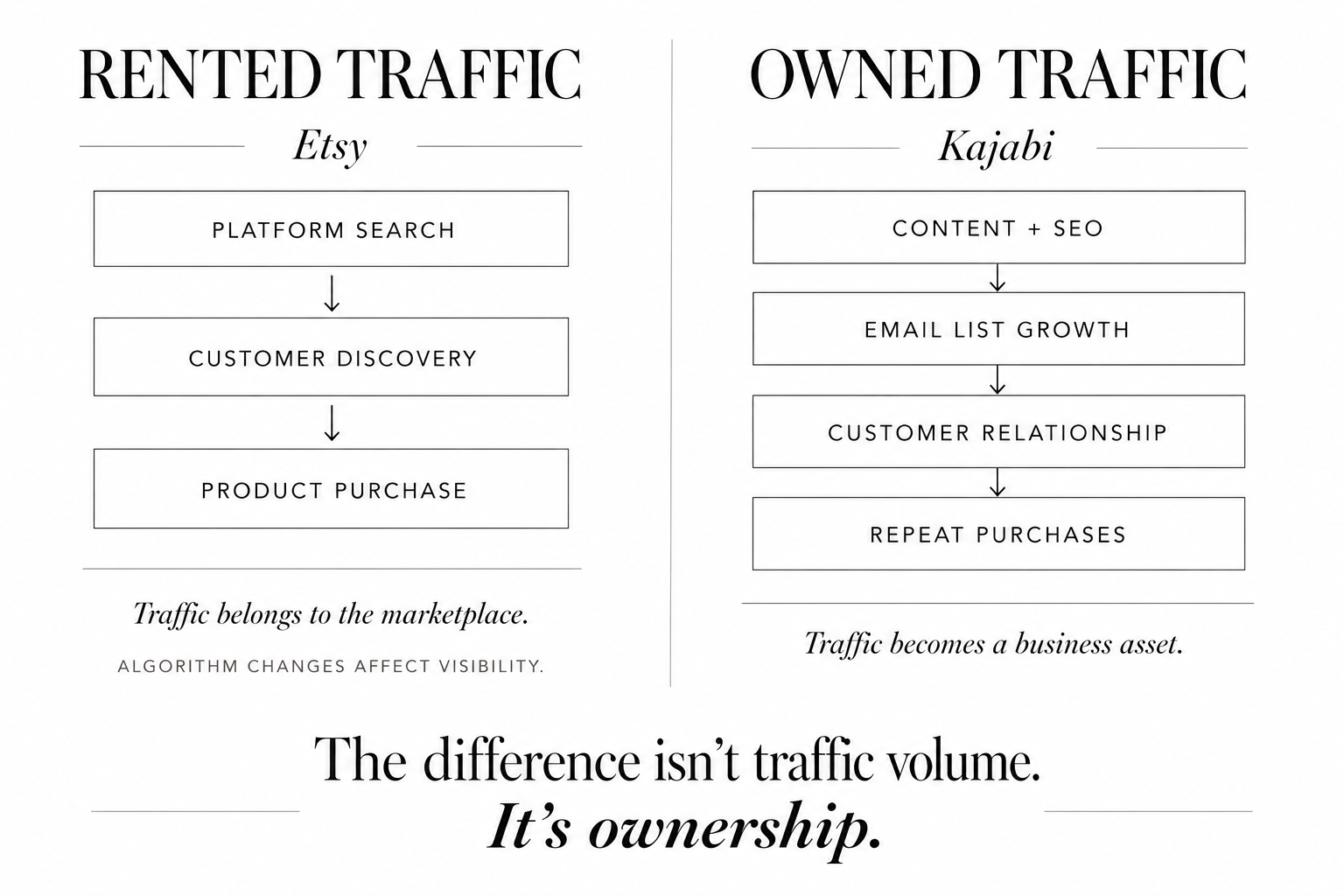
Kajabi also brings zero organic marketplace traffic. But what it gives you instead is more valuable long-term: a complete system for building your own. You get a website optimized for SEO, email marketing with full automation and segmentation, and the ability to create content that compounds over time. The traffic you build on Kajabi belongs to you. It doesn't disappear when an algorithm changes or when a platform decides to charge more for offsite ads.
Etsy is rented traffic. Kajabi is infrastructure for owned traffic. That distinction matters enormously once you're past the validation stage.
What Are You Actually Paying in Fees?
Let's run the real numbers, because the sticker price on each platform doesn't tell the whole story.
On Etsy, you're looking at a 6.5% transaction fee, a payment processing fee of around 3% plus $0.25, and a $0.20 listing fee per item. If Etsy runs offsite ads and drives a sale, you owe an additional 12% to 15% on top of that. The effective fee on a sale can reach anywhere from 11% to 26% depending on how that customer found you. On a $97 template, you could be keeping less than $75.
Gumroad keeps it simpler: a flat 10% on every transaction. No listing fees, no surprise ad charges. On that same $97 product, you net $87.30.
Kajabi works differently. You pay a monthly subscription, starting around $89 to $119 per month depending on the plan. In return, transaction fees on sales through Kajabi Payments are 0%. That fee structure looks expensive upfront and becomes very cheap very fast once you're generating consistent revenue. Sell $2,000 a month on Etsy at a 15% effective rate and you've handed over $300. Kajabi at $119 per month starts looking like a bargain at that scale.
The crossover point is real. Kajabi becomes cost-efficient for most digital product sellers well before they hit their first $2K month.
What Each Platform Is Actually Built For
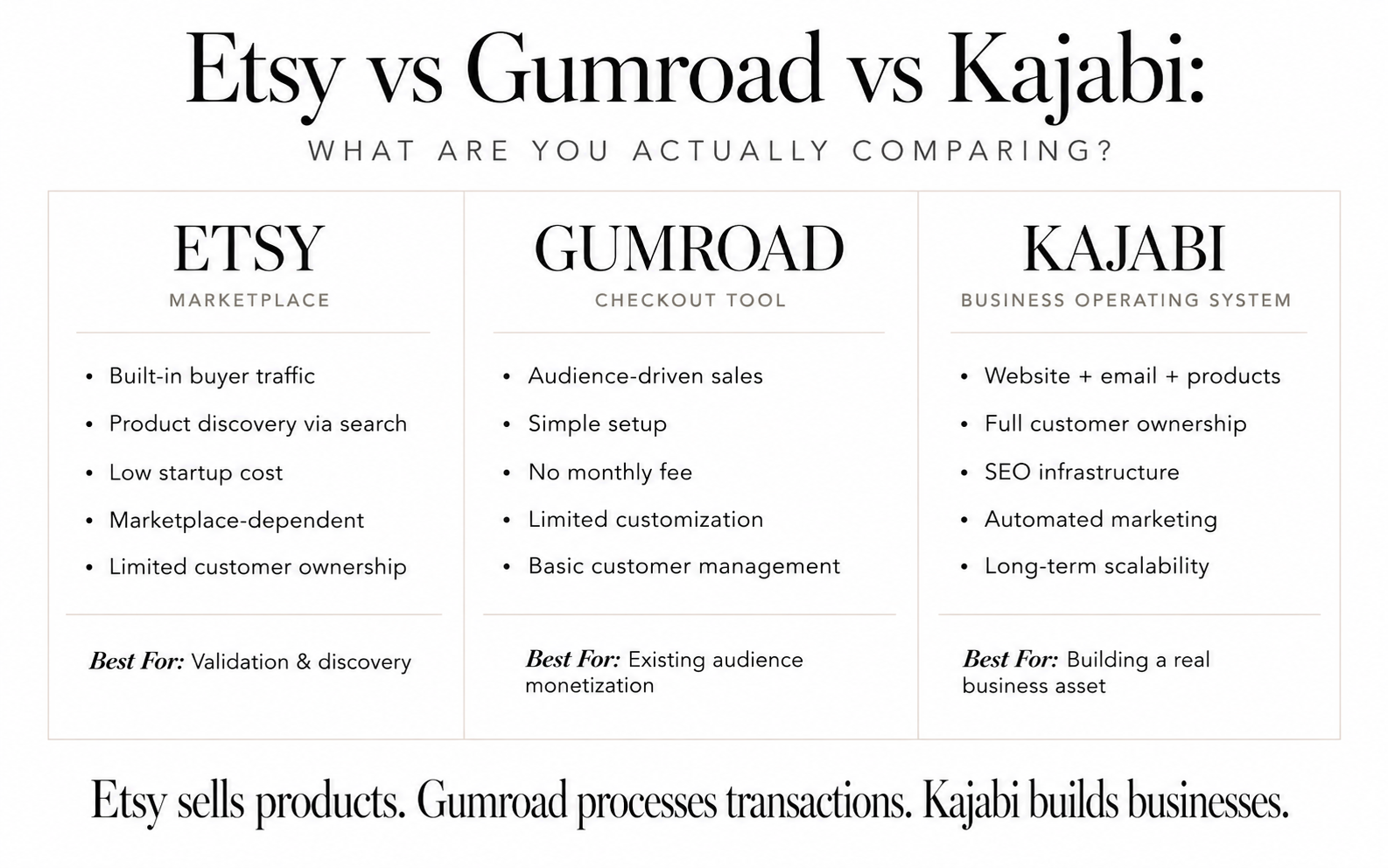
Etsy is a marketplace. Its job is to surface your products to buyers who are already browsing. It does that well for visually driven, impulse-friendly products at lower price points. Templates, printables, planners, Canva graphics. If someone is searching "personal trainer intake form template" on Etsy at midnight, and your listing shows up, that's a sale you wouldn't have made otherwise.
Gumroad is a checkout tool with a public profile. It's minimalist by design. If you have an audience on social media or a newsletter, and you want the fastest path from "I made something" to "here's a payment link," Gumroad is genuinely excellent at that. It strips away everything except the transaction.
Kajabi is a business operating system. Courses, memberships, group coaching programs, digital products, a website, email marketing, pipelines, and community, all inside one platform. Selling a digital product on Kajabi isn't just a transaction. It's a touchpoint inside a larger customer journey you control completely.
Those are three different tools solving three different problems.
The Storefront Experience
The experience your customer has when they land on your product page is not a minor detail. It shapes whether they buy, and it shapes how much they think your offer is worth.
On Etsy, you get up to 20 product images, a text description, and star ratings prominently displayed. The design is consistent across every Etsy store, because it's Etsy's design, not yours. You're a listing inside a marketplace, sitting next to your competitors.
On Gumroad, you get a branded page with a cover image, a rich-text description, and a clean checkout flow. It looks better than Etsy for premium products. But the visual real estate is limited, and the page structure is fixed.
On Kajabi, your sales page is whatever you build it to be. Full custom layout, your brand colors, your fonts, video, testimonials, FAQ sections, multiple CTAs, and no competitor listings anywhere nearby. If you're selling a high-ticket template collection, a course, or a signature program, the Kajabi sales page is a different category of experience entirely.
That difference in perceived quality translates directly to the price you can charge. A $47 template on Etsy is easy to believe. A $497 template suite on a beautifully designed Kajabi sales page is also easy to believe, in a way that a Gumroad page can't quite pull off.
Email Lists and Customer Ownership
Here's where the long-term picture becomes very clear.
When someone buys from you on Etsy, their email address appears in your order confirmation. You can see it. But Etsy's terms are strict: you cannot use that email address to market to them outside of fulfilling their order. You don't own that relationship.
Gumroad passes customer emails through to you automatically, and the platform has a basic follow-up email feature. It's functional. You have more ownership than Etsy. But the email tools are limited, and if you want serious automation or segmentation, you're integrating a third-party ESP on your own.
Kajabi includes a full email service provider built in. Every buyer enters your list automatically. You set up sequences, automations, and broadcasts from the same dashboard where you manage your products and website. You segment by purchase history, by tag, by behavior. You can promote a new offer to existing customers, re-engage people who didn't finish a course, or run a launch sequence, all without a single third-party integration.
Customer relationships are the actual asset in any digital product business. Kajabi is the only platform here that treats building and owning that relationship as a core function.
The Scaling Formula That Actually Works
This isn't an either/or situation, and I want to be direct about that.
If you're starting out with no audience and no budget for a monthly platform subscription, Etsy is a smart place to validate. List your templates, find out what sells, build a track record. It costs almost nothing to start, and the built-in traffic gives you a real shot at early sales without grinding social media.
Once you're generating consistent revenue and you're ready to build something that lasts, that's when Kajabi becomes the obvious next move. You bring your proven products over, build a site that reflects your actual brand, and start owning the customer relationship properly.
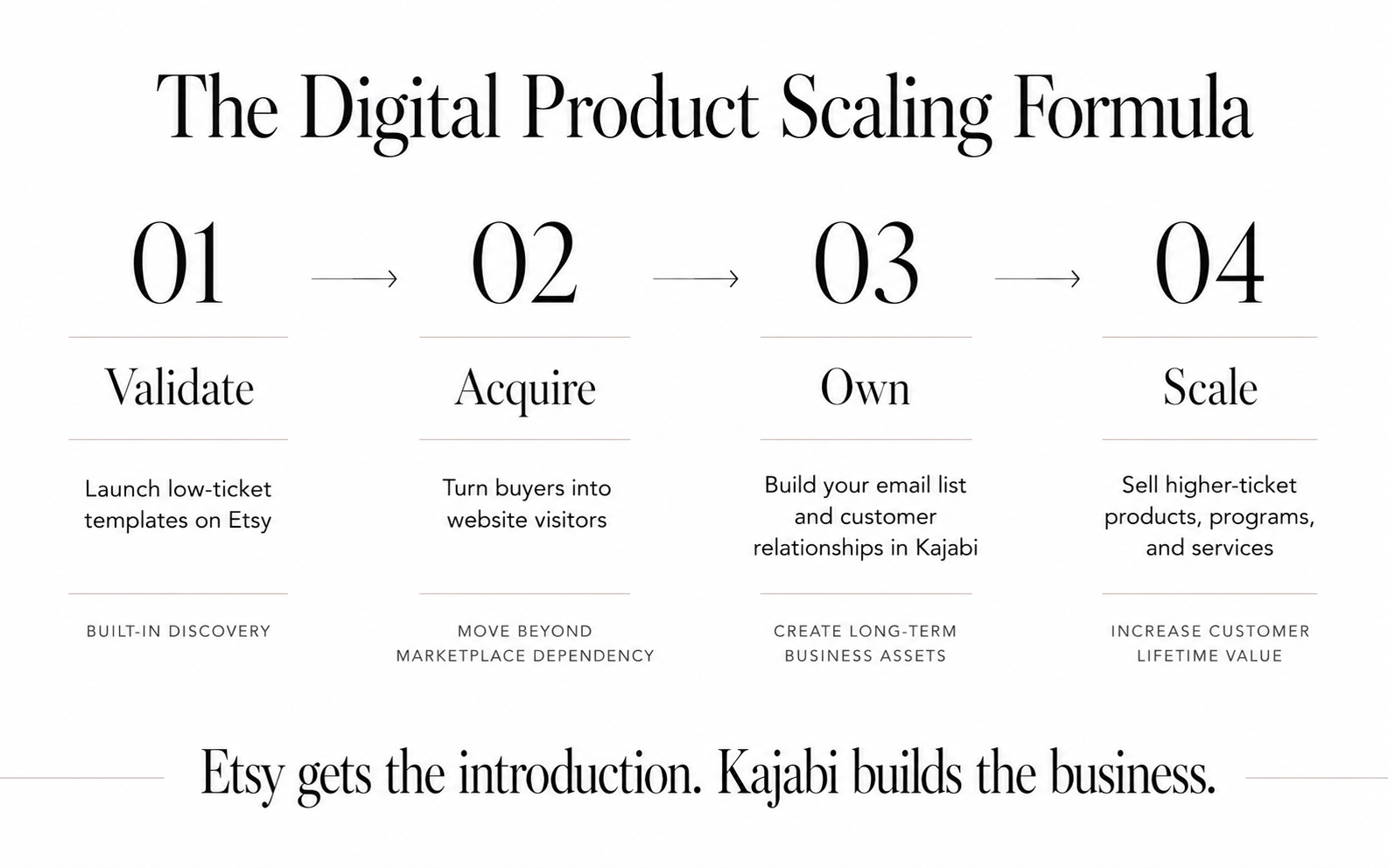
The formula that works: use Etsy as a top-of-funnel discovery tool that feeds your Kajabi ecosystem. A buyer finds your $27 Canva template on Etsy. Inside the product, there's a note pointing them to your website for more resources. They land on your Kajabi site, sign up for your email list, and six weeks later they buy a $197 coaching program template bundle. Etsy got the introduction. Kajabi made the business.
Who Each Platform Is For
Etsy is for creators with no existing audience who are selling visual, lower-priced digital products and want built-in discoverability from day one.
Gumroad is for creators with an established audience who want the simplest possible transaction with minimal setup and no monthly fee overhead.
Kajabi is for serious digital product sellers who are building a long-term business with multiple revenue streams, and who understand that owning their customer relationships and their platform is not optional at scale.
The Bottom Line
The platform you use shapes the business you can build.
If you're selling a $27 printable and you have zero audience, start on Etsy. That's an honest answer. But the real opportunity isn't choosing between these platforms. It's using them together intentionally.
Here's how I run my own business: low-ticket digital products on Etsy act as paid lead magnets. Someone finds a $27 template, buys it, loves the quality, and now they're in my world. They're not a cold lead. They're a buyer who already trusts my work. From there, a percentage of them naturally migrate toward higher-ticket offers, whether that's a full template collection, a coaching program, or a done-for-you setup. Etsy does the discovery. Kajabi handles everything that comes after.
That's the dual strategy worth building toward. Etsy at the top of your funnel, Kajabi as the business behind it.
If you want to build this out properly, I have two resources that will help. My Etsy Digital Product Playbook covers exactly how to set up and grow a low-ticket Etsy shop that feeds your bigger business.
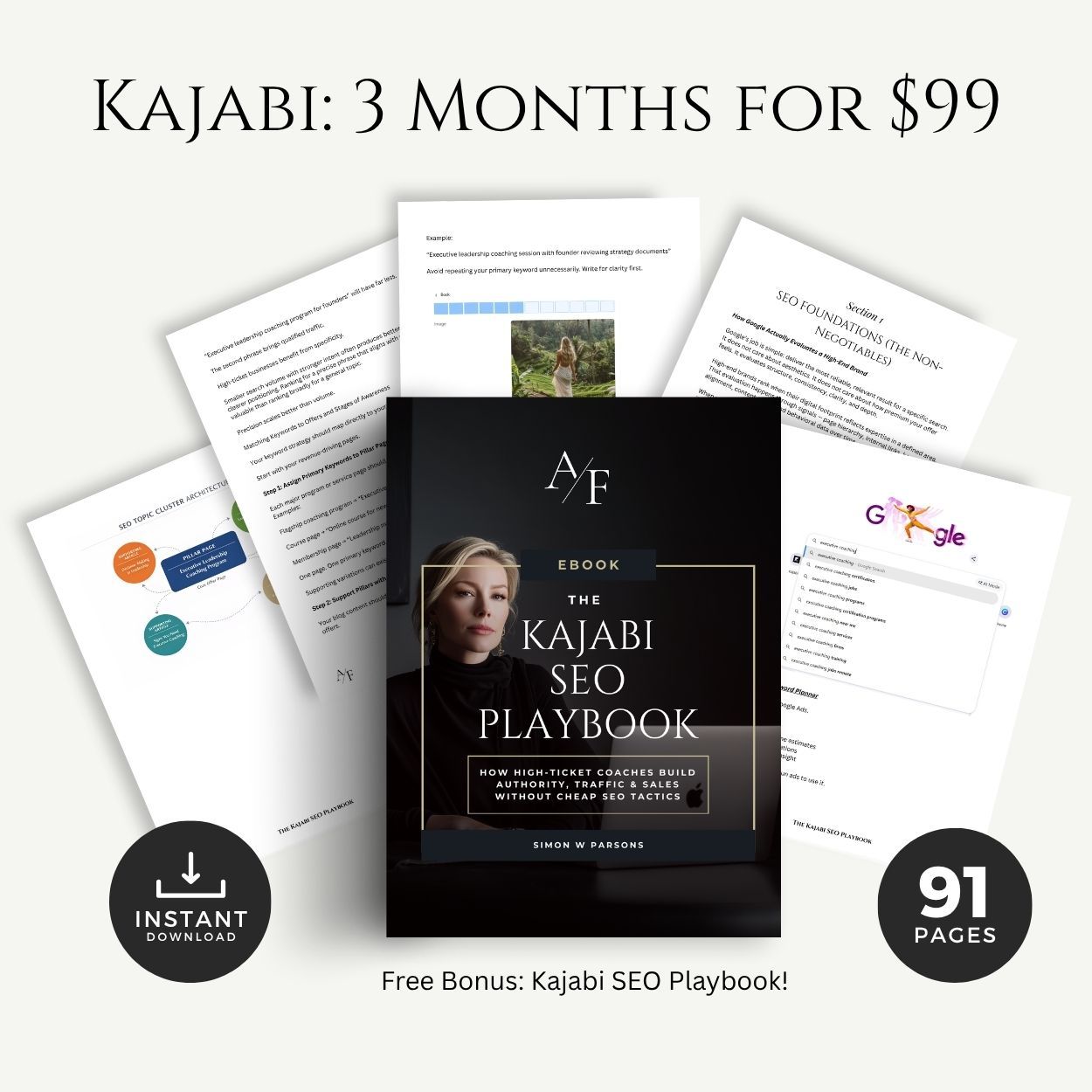
And if you're ready to bring everything into Kajabi, you can sign up through my affiliate link and get my 60-page Kajabi SEO Playbook as a bonus, so your Kajabi site starts ranking in Google from day one. Get started with Kajabi + the SEO Playbook here.
Start where you are. Build toward owning it all.
In my next article I'll show you how to get started with Passive Income as a beginner. Even if you are seasoned coach or consultant, adding digital products will attract new clients that you haven't had before and give you some extra income to put towards expanding your business.
Simon
Grab my free High Ticket Coach Branding Guide
A free guide for coaches, consultants, and creators who are ready to ditch the DIY look and step into a cohesive, premium brand presence that sells.
We hate SPAM. We will never sell your information, for any reason.