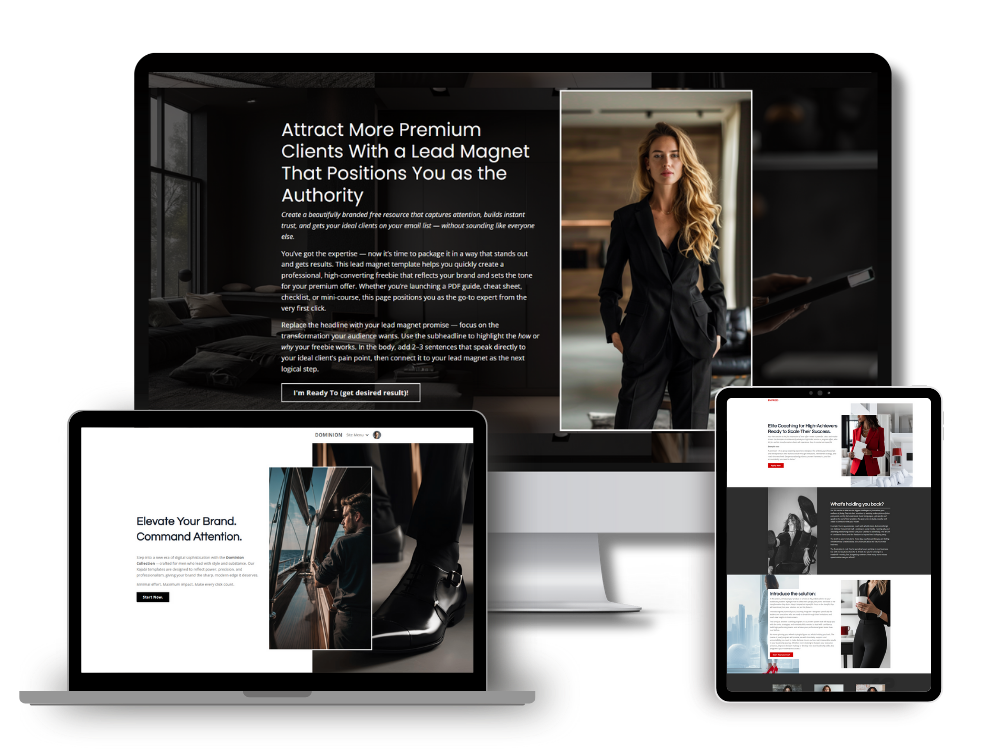
Canva Templates for Personal Trainers: What to Look For
Aug 27, 2026
Type "personal trainer templates" into Canva's own search bar and you'll get page after page of the same thing: neon gradients, stock dumbbell clip art, and fonts that belong on a 2019 bootcamp flyer. None of it looks like the kind of brand a trainer charging premium rates for one-on-one coaching wants attached to her name.
That gap between what's free and what a serious fitness business actually needs is exactly why template kits built specifically for personal trainers exist. If you've already read our post on pairing a Kajabi website with a matching Canva system, you know the two need to work together, not compete for attention.
This guide covers the Canva side of that equation: what a real personal trainer template kit should include, where the free stuff falls apart, and what to check before you hand over your card.
Why personal trainers need branded templates, not just workout logs
Most trainers think about templates in terms of programming: workout logs, meal plans, progress trackers. Useful, but that's not what a potential client sees first.
A prospective client finds you on Instagram before she ever sees your programming. She looks at your grid, your stories, maybe a flyer a friend forwarded her. She's forming an opinion about whether you're legitimate before she reads a single word of your bio.
If your Instagram posts use one font, your intake form uses another, and your flyer looks like it was made by a different business entirely, that inconsistency reads as amateur. Not because any single piece looks bad on its own, but because nothing ties together. A coherent visual system does more to signal "this trainer is worth premium rates" than any single well-designed post ever could.
This is the same principle behind your website. A polished site paired with mismatched marketing materials undercuts itself. The templates you use for social media, flyers, and client paperwork need to feel like they came from the same brand as your website, because they did.
It matters even more for trainers pricing themselves at the higher end of the market. A $40 gym class doesn't need a brand system behind it. A private client paying for a six-month coaching package is buying trust as much as programming, and trust is built visually long before it's built in a consultation call.
What a real Canva template kit should include (social, flyers, forms)
A complete kit covers more ground than most trainers expect when they start shopping.
Social media templates are the obvious starting point: Instagram feed posts, story templates, and a layout system that lets your grid look cohesive instead of like a scrapbook. But social is only one piece.
Print marketing still matters for trainers building local clientele. Flyers for gym bulletin boards, referral cards, and local ad templates need to hold up in print, not just on a phone screen.
Underneath all of it should be one shared system: the same two or three fonts, the same color palette, the same photo treatment, applied consistently across every piece. That's the difference between a template kit and a folder of unrelated files that happen to be fitness-themed.
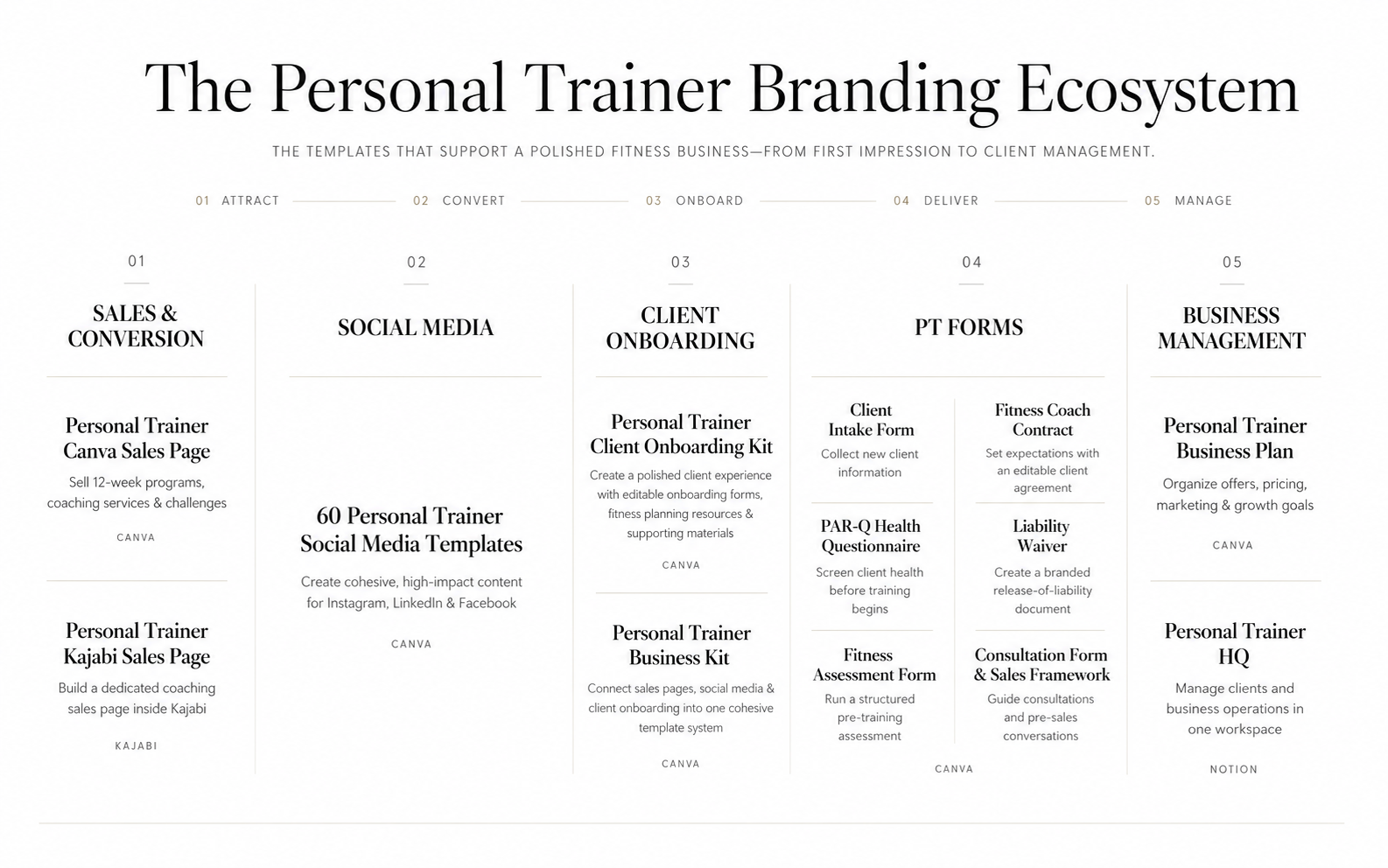
The piece most kits skip entirely is client-facing paperwork. Intake forms, consultation forms, and liability waivers are documents every client sees during onboarding, and they're usually the least designed part of a trainer's business.
A generic Google Form or a plain Word document undoes the premium impression your Instagram just built. A kit that includes branded forms alongside your social and print templates closes that gap. It's worth checking our PT Trainer Template collection to see what a full system looks like across all three categories.
Free vs. paid: where the free templates fall short
Free templates aren't worthless. They're a reasonable starting point if you're testing whether Canva itself is a tool you want to use.
Where they fall short is consistency. A free template is a single design, not a system. You'll find one nice Instagram post template on one site and a completely different-looking flyer on another, and stitching them into a brand takes more design skill than most trainers have time to develop.
Licensing is the other issue most trainers skip until it's a problem. Some free templates restrict commercial use, which matters the moment you're using a design to sell a service. And because free templates are, by definition, available to anyone, there's a real chance a competitor two states over is using the exact same layout.
There's also a time cost that's easy to underestimate. Pulling five free templates from five different creators and trying to force them into one brand usually takes longer than just buying a kit that was designed as a set. Most trainers who go this route give up on the print or forms piece entirely and just accept the mismatch.
Paid kits built for personal trainers specifically solve both problems: one cohesive design system, and something you're not sharing with every other trainer who searched the same term you did.
What to check before you buy
Editability matters more than it sounds. Some templates lock certain elements, meaning you can swap the photo but not the font, or change the text but not the color palette. Before buying, check whether the kit is fully editable in Canva, not just partially customizable.
Brand consistency across pieces is the whole point of buying a kit instead of piecing together individual templates. Look for a preview of the full set, not just a single flagship design, so you can see whether the social templates, flyers, and forms actually share a visual language.
Mobile use is easy to overlook and hard to undo. Most of your clients will see your Instagram posts on a phone, and most of your consultation forms will be filled out or reviewed on one too. A template that only looks good at full desktop size isn't finished doing its job.
Print readiness matters just as much if flyers are part of your plan. Check whether the flyer templates are set up with proper bleed and export at print resolution, not just sized for a screen. A template that looks sharp on Instagram can come out blurry or cropped wrong at the print shop if it wasn't built for both uses.
Also worth a quick check: how many pieces are actually in the kit, and whether the seller updates it over time. A kit with three social templates and nothing else isn't a system yet. It's a starting point.
Most "coach" template kits on the market are built for a generic coaching audience and then relabeled for fitness by swapping in a dumbbell icon. That's a repurposed template, not a personal trainer template.
A/F's Personal Trainer Templates are designed for this niche specifically, from the ground up. The visual language is editorial and dark and athletic, rather than the neon-and-clip-art look that dominates the free options.
That aesthetic is built around how fitness businesses actually operate: client-facing, appointment-driven, and reliant on trust before someone hands over their money.
Client forms are treated as a core part of the kit, not an afterthought. Intake forms, consultation forms, and waivers are designed to match your social templates and flyers exactly, so the first document a new client fills out looks like it came from the same premium brand as your Instagram grid, because it did.
The design decisions reflect the industry too. Fitness photography reads differently than a headshot for a business coach, so the layouts account for full-body shots, movement, and gym or outdoor settings, rather than a portrait-first template built with a seated coaching photo in mind.
The color and typography choices follow the same logic: dark and athletic instead of the pastel-and-script look most coaching kits default to.
The kit also grows with the business instead of getting outgrown in six months. A trainer who starts with social templates and a basic intake form can add flyers or an expanded onboarding kit later without starting a new brand from scratch, because everything shares the same foundation from day one.
If you've been patching together free templates from three different sources and wondering why your marketing still doesn't quite look like your website, that mismatch is the actual problem, not your content.
Browse the full Personal Trainer Templates collection to see the complete system, from social and print to client paperwork, all built to work together from the start.
Simon
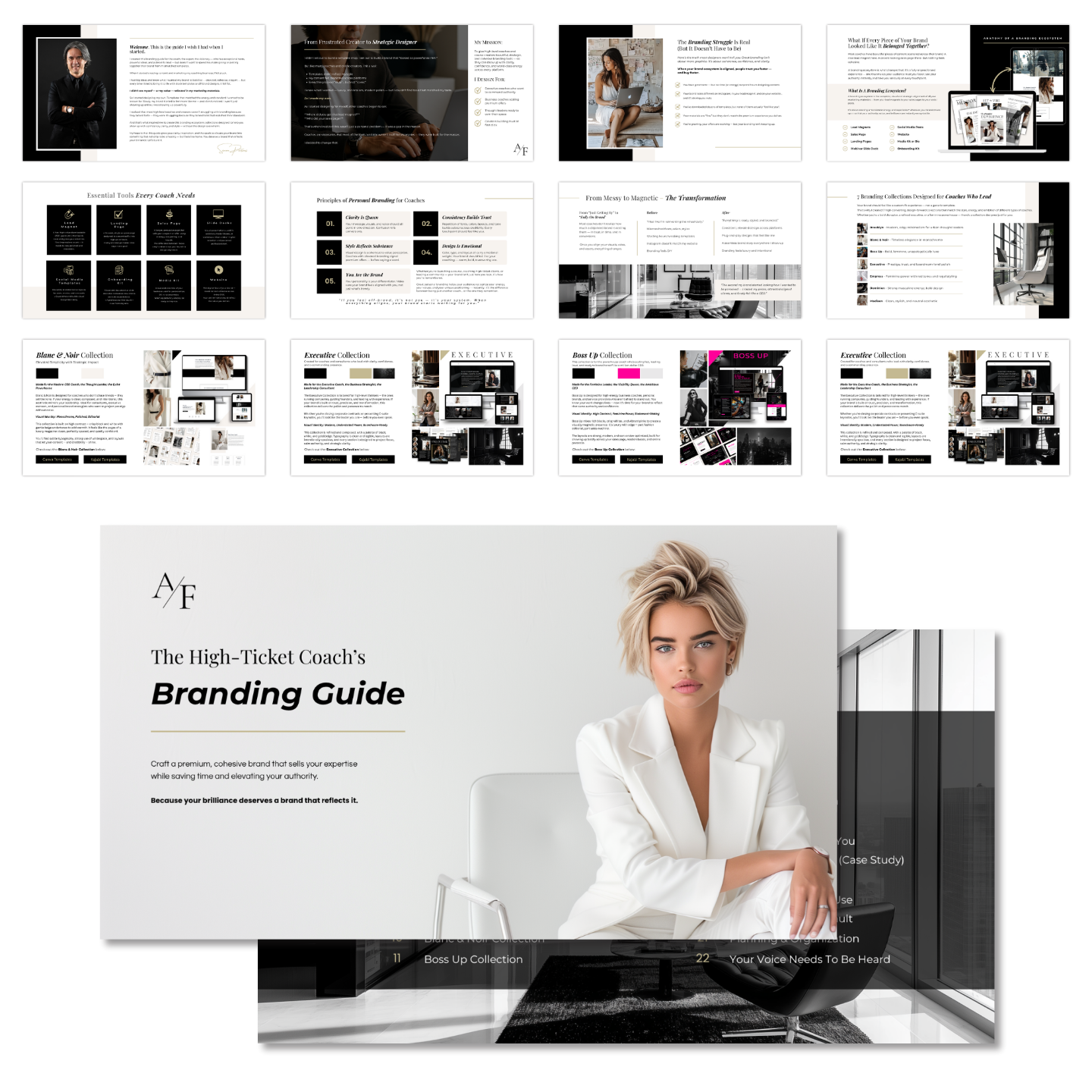
Grab my free High Ticket Coach Branding Guide
A free guide for coaches, consultants, and creators who are ready to ditch the DIY look and step into a cohesive, premium brand presence that sells.
We hate SPAM. We will never sell your information, for any reason.